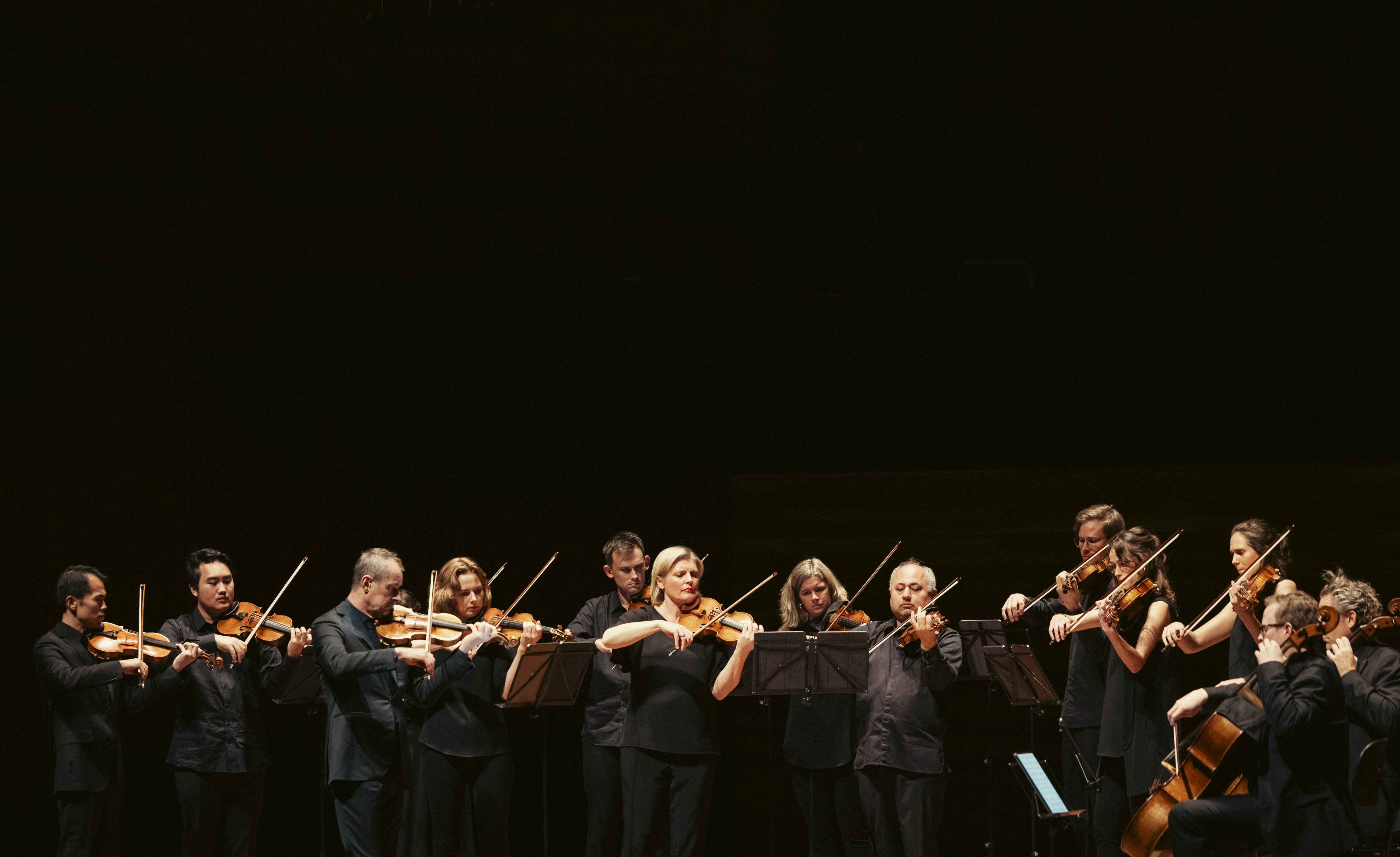
There is something quietly transformative about Franz Schubert’s music. It invites us to step outside ourselves, and to notice small, luminous details. This spirit is at the heart of our upcoming national tour, Schubert’s Fantasy & Octet, a program that celebrates the composer’s extraordinary emotional range and deeply human view of the world.
Richard Tognetti’s affinity for Schubert is evident in every note he plays. On this tour, he directs an ensemble featuring a handpicked selection of Australia’s top wind players: Clarinet David Griffiths, Bassoon Todd Gibson-Cornish and French Horn Carla Blackwood, who join a string quintet on stage for two exquisite works that showcase Schubert as a master of chamber music.
For Carla Blackwood, Schubert’s music is synonymous with the feeling of a meditative enjoyment of the great outdoors. “For me, Schubert’s music is like getting out into nature. It’s like going for a walk where you are reminded to get out of your head, or your phone, and to notice the beauty of life around you.”
Schubert is a composer whose music often seems to unfold like an exploration of a landscape, moments of solitude giving way to warmth and company. Blackwood speaks of Schubert’s ability to hold depth and lightness together, to contemplate life and its complexities without becoming weighed down: “Still ruminating and contemplating, with a great depth and deep humanity… Schubert’s music reminds you that there is lightness within that.”
“The combination of strings and winds creates an excitingly broad palette of colours… it can feel like painting, finding ever new ways to connect with my colleagues and paint new worlds of colour and expression.”Carla Blackwood
At the heart of this tour is Schubert’s Octet, a work that feels grand in scope, yet intimate and conversational in character. For Blackwood, listening to it is like travelling through space and time:
“Listening to the octet makes me feel like I am going for a walk in the Austrian countryside, through the forest, across fields, through villages and past churches… at times thinking deeply about life, and at other times enjoying the simplicity and humanity of the sunshine.”
This sense of shared journey is mirrored in the way the music is made. The Octet’s unique scoring, a blend of strings and winds, creates a rich palette.
“The octet is a delight to play,” Blackwood says. “The combination of strings and winds creates an excitingly broad palette of colours… it can feel like painting, finding ever new ways to connect with my colleagues and paint new worlds of colour and expression.”
Bassoonist Todd Gibson-Cornish also speaks of the Octet as a journey, one that moves through shifting emotional terrain, guiding both musicians and audience along the way.
“Each movement opens a different world, from the contemplative, reflective stillness of the Adagio, to moments of warmth and playfulness across the inner movements, and ultimately an uplifting sense of arrival in the finale.”
“For me, playing this music is about sharing that journey, inviting the audience to feel, reflect, and leave with a sense of lightness and connection.”Todd Gibson-Cornish
For wind players, Schubert offers distinctive voices that both contrast and harmonise with the strings.
“As a bassoonist, I love how the wind instruments bring colour and character to the ensemble,” Gibson-Cornish explains. “Schubert uses those voices together with the strings in a way that brings life to a sound world far beyond what you might expect from the individual instruments.”
That sense of collective expression lies at the core of the work.
“For me, playing this music is about sharing that journey, inviting the audience to feel, reflect, and leave with a sense of lightness and connection.”
Clarinetist David Griffiths highlights one of the most intimate moments in the Octet: the opening of its second movement.
“The opening of the second movement of Schubert’s Octet is, to me, one of the most beautiful melodies ever written for the clarinet.”David Griffiths
It’s a melody he returns to often, not just for its beauty, but for its purity of expression.
“Schubert was a master of song, and that gift is everywhere in this line. As I play, I’m always trying to recreate the human voice and make the purest sound possible.”
When the violin joins the clarinet, the music becomes a shared conversation that feels intensely personal yet universal.
“Suddenly it becomes this glorious duet from which the whole movement unfolds. Schubert so clearly understood the clarinet, and the way that it can recreate the human voice.”
Across the entire program, this sense of shared humanity is consistently evident. “Playing Schubert always feels deeply emotive and immersive,” Griffiths says. “His music moves so naturally between calm and intensity… In the hall together, we share a quiet, almost meditative experience that feels both personal and universal.”
Perhaps this explains Schubert’s ongoing resonance with today’s audiences, and why the ACO performs pieces from his extraordinary catalogue regularly. His music reminds us to slow down, to listen, not only to the notes, but to one another. As Blackwood beautifully puts it, “I listen to Schubert when I want to feel lighter, freer… For me, it is the musical equivalent of going for a walk by the river, to reconnect with myself and what really matters.”
Schubert’s Fantasy & Octet is an invitation to walk together, across inner landscapes, through shared silence and warmth, and into music that feels as luminous and uniting now as it did two centuries ago.