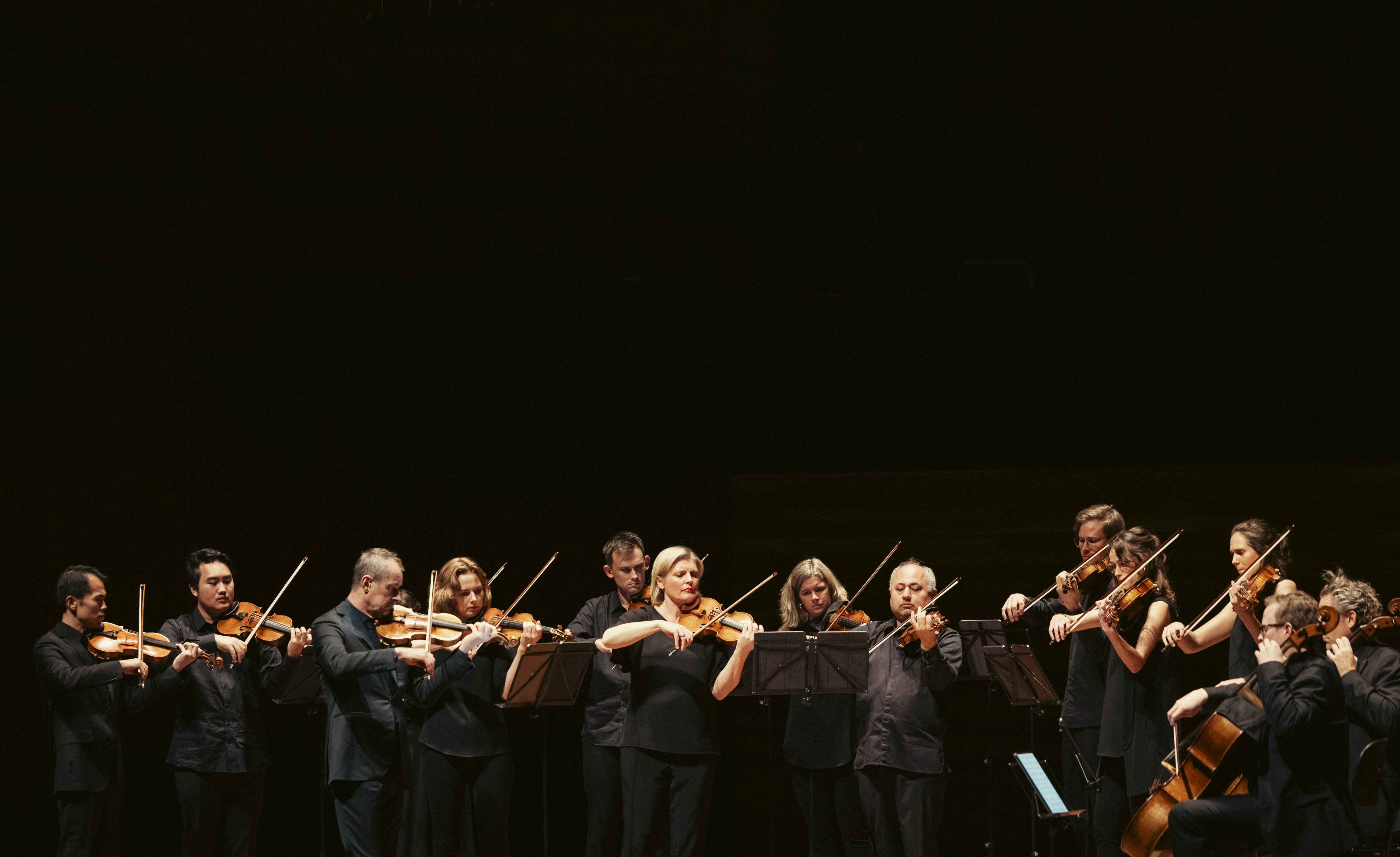
Ahead of his performance of Rachmaninoff’s Rhapsody, celebrated pianist Dejan Lazić reflects on his long history of collaboration with the Australian Chamber Orchestra. Written by James Bradley.
Dejan Lazić laughs when asked about his first encounter with the Australian Chamber Orchestra. “It was in my birth town, Zagreb, in Croatia, when I was 12. My mother used to take me to concerts at the Lisinski Concert Hall on Saturday evenings. All the great orchestras came. The Vienna Philharmonic, the Berlin Philharmonic, the London Symphony. And then one week the ACO came, and they were dressed in hula shirts and played like no other orchestra I’d ever heard.”
In the 35 years since that afternoon, Lazić has established himself as one of the world’s most celebrated soloists, playing regularly with orchestras such as the London Philharmonic, Chicago Symphony and Royal Concertgebouw Orchestra. He has developed a long and creatively fruitful relationship with the ACO, recording and performing with them many times, most recently as part of 2019’s Celebrating Mozart national tour, where he played Mozart’s Piano Concerto No.14 and Rondo Concertante, his arrangement of the third movement of the Piano Sonata in B-flat major, K.333.
Lazić speaks with genuine delight about the excitement of working with the ACO and his special bond with Richard Tognetti. “The ACO are unpredictable. I know them so well, and every time they amaze me.” Part of that is about a preparedness to take risks. “To use Richard’s phrase, they’re not afraid of jumping off the cliff.”
This is not simply about novelty for novelty’s sake. Lazić says Tognetti’s capacity to find something fresh in a composition depends upon his readiness to meet the piece anew every time. “That comes really from deep within. You are a different person from the last time you played it. You’ve learned things, you’ve studied, you’ve read. And that’s how it should be. In my opinion, that is what you do as a creative artist.”
He believes that sense of adventure is shared by the ACO audience. “I’ve hardly experienced anything like them. They go from quiet and attentive to loud and jubilant in the one performance. So it’s the ideal mix. And they trust the ACO. They’re not afraid if there’s something they don’t know; instead they say ‘this is interesting, let’s hear it.’ And that’s really fantastic.”
Lazić is particularly excited to be performing Rachmaninoff’s Rhapsody on a Theme of Paganini, Op.43. Inspired by the last of Paganini’s 24 Caprices for Solo Violin, Op.1, it is a work that is famous not just for its emotional depth and complexity, but for the technical demands it makes of both the soloist and the orchestra. The challenge posed by the speed and leaps across the keyboard in the 24th variation in particular daunted even Rachmaninoff himself. At the premiere in 1934 he drank a glass of alcohol to calm his nerves, leading to the 24th being dubbed the “crème de menthe variation”
It is also a work with which Lazić has had a long relationship, having first performed it in 2007 with the Hong Kong Philharmonic. He sees its complexity and emotional range as a reminder of “how profound Rachmaninoff was, and how sensitive”, both as a performer and a composer.
Lazić’s approach to the Rhapsody is informed not just by years of study and performance, but by his experience recording the Piano Concerto No.2, Op.18 with Kirill Petrenko and the London Philharmonic Orchestra in 2008. “The Second Piano Concerto was another piece I wanted to grow with so I knew the whole story. But that helped me understand that the whole thing was a long process. And it was only after he completed symphonies and concertos and solo music and chamber music that Rachmaninoff wrote the Paganini Rhapsody.”
One of the challenges of the Rhapsody is its structure, which is made up of 24 variations, most of which are less than a minute in length. Yet while this might suggest the Rhapsody lacks “the long line” of a concerto, Lazić argues it cannot be treated as 24 discrete pieces. Instead, the individual variations are more like “cells” that exist independently but “function within a body … We need to be aware of these small building blocks, because without them we cannot exist, but we also need the whole.”
Lazić argues “the true craftsmanship” of the Rhapsody lies in the way this whole is constructed, and the “special glue” that binds the individual pieces together. “You don’t have a clear stop after every variation, so many variations either come from the previous one or lead towards the next one.” Rachmaninoff’s use of tempo also plays an important part, subtly increasing from one variation to the next.
The Rhapsody is bound together by tonalities as well. “You start in A minor, which is all white keys, but then the famous slow 18th variation is in D-flat major, which is all black keys. And then we make a full circle back to A minor. So it’s not only black and white he visits, but all the colours. We go from slow to really fast. In other words, everything a composer should achieve has been achieved, but it’s so distilled, it’s so fresh and crisp. That’s true mastery, to boil down the length, but still say everything.”
These complexities mean that even after spending half his lifetime performing it, Lazić does not feel he has come to the end of the Rhapsody’s possibilities and complexities. “Every time I perform this piece, I discover new things. It’s like revisiting a painting … Even a famous painting like Vermeer’s Girl with a Pearl Earring, which you see reproduced everywhere, you see that in the museum and you realise there are details you haven’t seen before. And the same goes for a great piece of music. Every time brings you new information, new data. Especially in this case, because although I’ve played it for 20 years I’ve never played it in this chamber music setting. But to play it with a soulmate like Richard and the ACO, that’s a real privilege.”
Click here to discover and book Rachmaninoff's Rhapsody, with guest musician Dejan Lazić, touring to Newcastle, Melbourne, Sydney, Wollongong, Brisbane and Canberra, 5-18 Feb 2026.