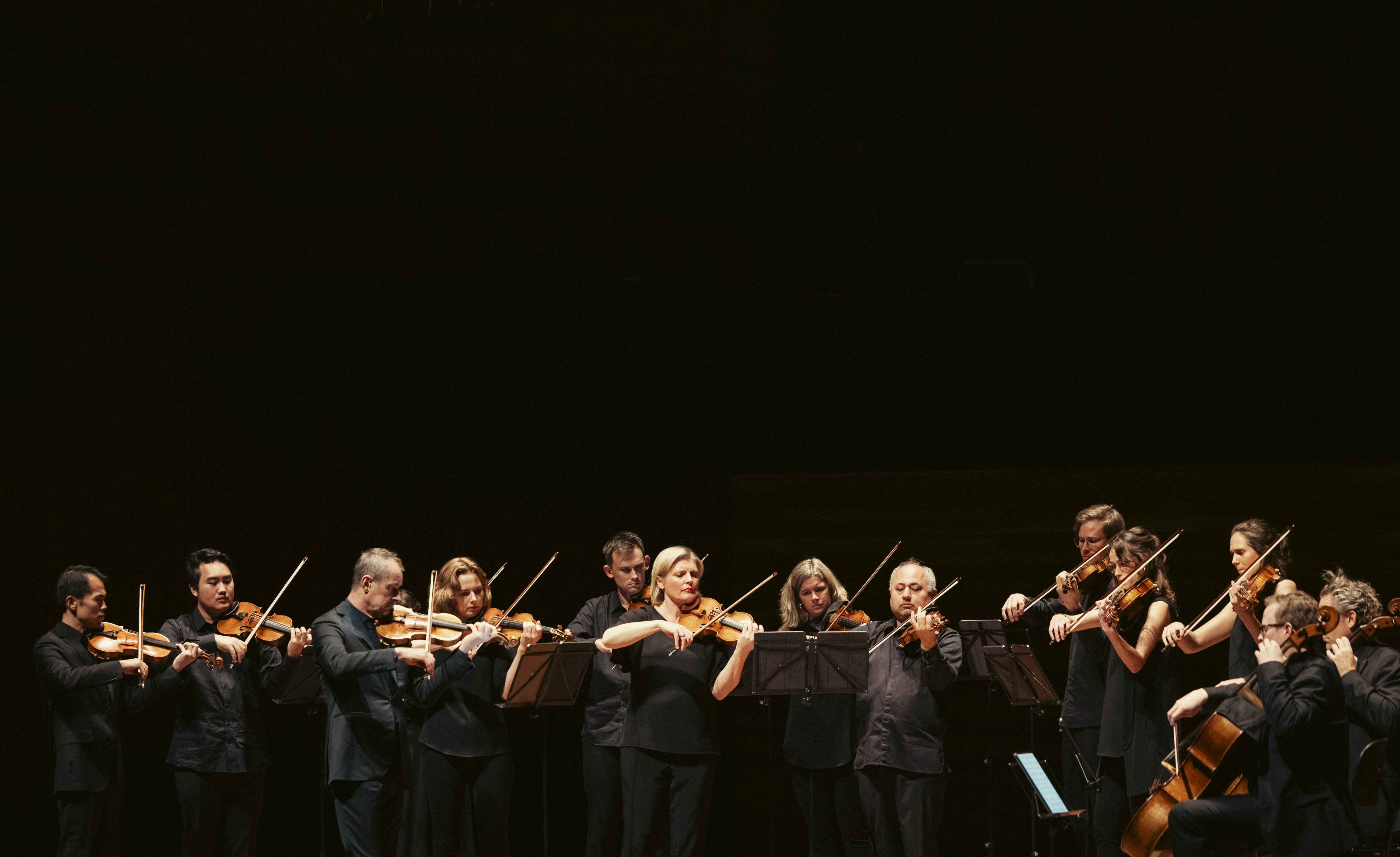
Ahead of the upcoming ACO Up Close: William Barton and the Brodsky Quartet, Jacqueline Thomas, Brodsky Quartet Cello, has penned an emotive program walkthrough, an explainer of the evening's delicate weave of Australian and European music.
How many different ways has humankind produced sounds with a hollowed-out piece of wood... from drumming to blowing to plucking and scraping, the variations through the ages and across continents are endless. Thousands of years ago, the Aboriginal yidaki, possibly the world's oldest musical instrument, was created from eucalyptus trunks hollowed out by termites; not long afterwards ancient lyres emerged in the Middle East and later, viols in Europe paved the way for today's violins, violas and cellos; around the same time, whilst crumhorns developed into oboes and flutes, the wind instrument of the Māoris, the pūtōrino, was shaped and carved to mimic the cocoon of a case-moth. And the source of all these instruments; the noble tree, the life-breath of the planet, a species endlessly tenacious through millions of years of challenges to its very existence.
Tonight these elements converge, along with the human voice, to bring a rich and varied sound world through a sonic dialogue spanning millennia, an extraordinary arc through time and culture, where First Nations wisdom converses with the rich tradition of European chamber music and composers of today.
We begin with an improvised introduction on the yidaki, giving way to the pure sounds of the young Henry Purcell's Fantasia in D minor, a meandering exploration of falling 4th and rising 5ths.
William Barton's improvisation takes us seamlessly into Peter Sculthorpe's Jabiru Dreaming, a tribute to his beloved Kakadu and featuring the sounds of tribal music, the gait of the Jabiru stork and insects of the Interior. In both strings and yidaki, the boundaries are pushed open to create wind, string and percussive sounds, embracing the inspiration behind this powerful music.
Robert Davidson's evocation of the island Minjerribah (or North Stradbroke) pulsates with the heat and rhythms of sea and land, a joyous celebration of life; originally written for strings, this is a specially adapted version by the composer for these forces.
Janacek's String Quartet No 1, titled The Kreutzer Sonata after the Tolstoy short story of the same name, is a four movement work exploring the tragic and murderous tale of a husband's jealousy. It is a fine example of Janacek's unique musical language; fast, often indecipherable patterns mimicking verbal utterances and speech patterns, as well as folk-influenced themes and dramatic outpourings of emotion.
After the interval, a peasant dance from Stravinsky's Three Pieces for String Quartet like a carnival of players each absorbed in their own part in the parade, leads us into the calling sounds of the pūtōrino, as reimagined by New Zealand composer Salina Fisher in her String Quartet Tōrino . The instrument has three distinct voices; the trumpet, the flute and a 'middle' voice with an eerie quality, inspired by the case moth of its origins. Quarter-tones are used to startling effect, echoing the haunting timbres of the instrument.
Andrew Ford's Eden Ablaze is a lament to the 'Black Summer' of 2019, when the subtropical rain forest of Gondwana was largely destroyed. Unlike regular regenerative bushfires, this forest never usually burns; the notes depict this loss of innocence for the environment and its emotional impact. First a ghostly evocation of Handel's Xerxes aria praises the shade of trees whilst burning embers crackle, then we hear the raging inferno, exploding and jumping, eventually dying down whilst ashes float in the air.
The calming sounds of ancient folkloric Ireland emerge with the traditional song She Moved Through the Fair, transcribed and sung by Paul Cassidy, and the improvised vocals of William Barton takes us through to the final work on the programme, his own Square Circles Beneath the Red Desert Sand. The piece is deeply connected to the spirits of his country, Mount Isa and Kalkadunga, and plays with the juxtaposition of the different elements –organic, created and spiritual – in this vast arid landscape.
Click here to discover and book ACO Up Close: William Barton and the Brodsky Quartet, at ACO On The Pier, 27 February 2026.