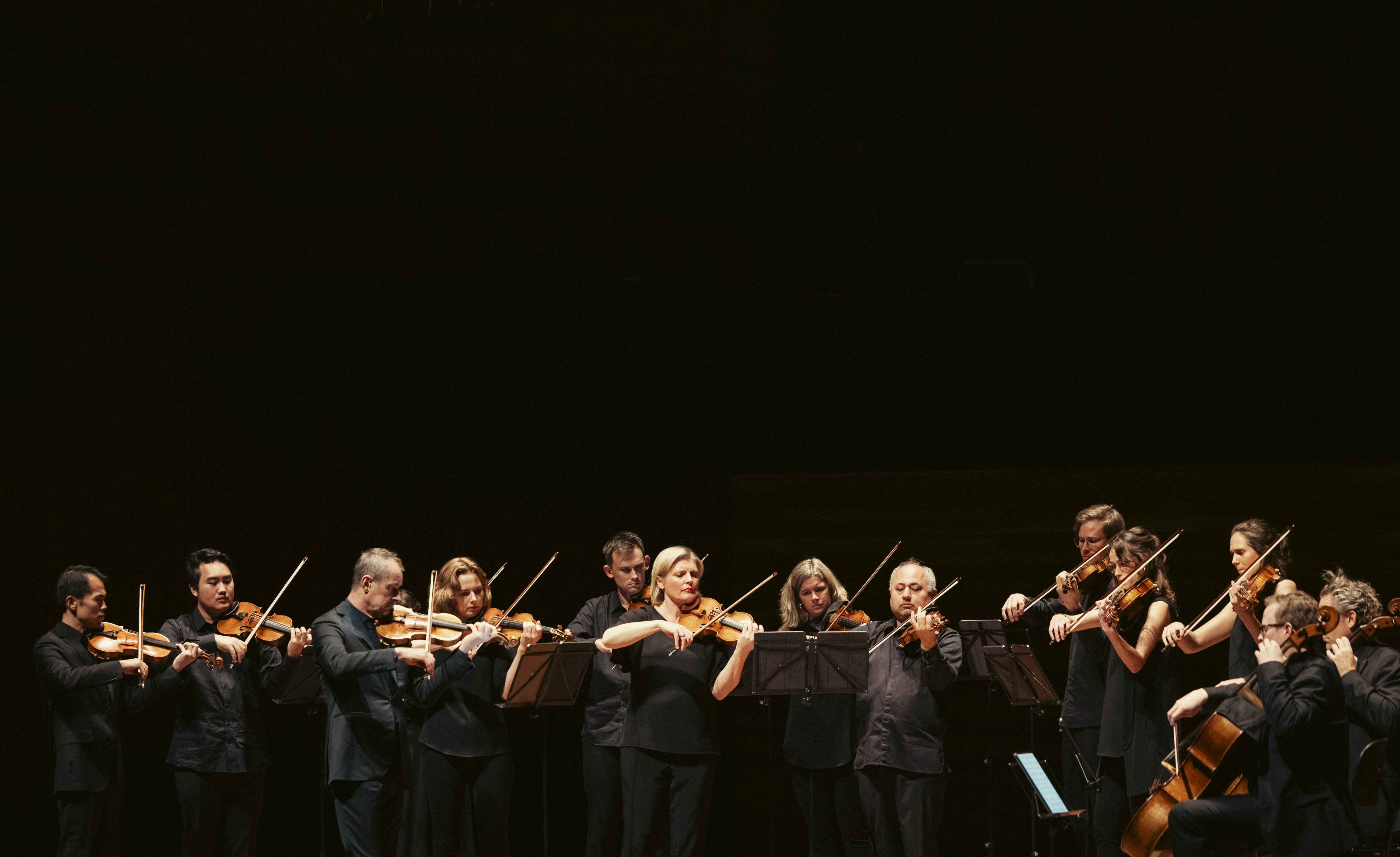
As humanity’s horizons grow darker, American composer John Luther Adams holds to his faith in the sublime.
Adams explores this concept in the essay below, ahead of our first tour of 2026, Rachmaninoff's Rhapsody, which features his new work, Horizon.
Geographers employ the poetically evocative term “pole of inaccessibility” to describe the most geographically remote location, the place that lies farthest from the edge. On land, a pole of inaccessibility is the place that is farthest from the coast. At sea, it’s the place that is farthest from land. Each continent – Eurasia, North America, South America, Africa, Australia and Antarctica – has such a place. And somewhere out in the South Pacific lies Point Nemo, a location postulated as the farthest from land from anywhere else on Earth.
The unfathomably complex fractal geometry and endless shapeshifting of coastlines make it impossible to locate these points with unchanging precision. You could be standing at a pole of inaccessibility without realising it and tomorrow it might’ve moved. Yet this elusive nature only deepens the mystical allure of the idea.
As a refugee from the suburbs, an orphan of a culture that has lost its deepest connections to place, my life has been a continuing search to find home.
In pursuit of my own private poles of inaccessibility, I’ve lived much of my life far from urban centers. As a refugee from the suburbs, an orphan of a culture that has lost its deepest connections to place, my life has been a continuing search to find home. My map and my compass have been music. For me, places become music and music becomes place. Listening to a place, learning to hear its music, I come to understand more deeply where I am and how I fit in. In my music I aspire to provoke for myself and the listener the experience of standing alone, immersed in a vast, beautiful, sometimes frightening place, and losing oneself within it. This is a hopelessly romantic aspiration.
Poles of inaccessibility stir in us those images of blank spaces on the map and “uninhabited” territory that drove the so-called “explorers” of imperial nation-states and led to the brutal colonisation of so many places. But today, with more than eight billion humans living on Earth, we inhabit a world in which there are no such places. No unclimbed peak in the Himalayas, no abyssal depth in the Pacific, no ice shelf in Antarctica is beyond the reach of our satellites and drones, our probes and surveillance systems. At the same time, many of us now live much of our lives in the ultimate non-places of the internet, a liminal labyrinth of windowless rooms and endless empty hallways leading nowhere. Perhaps these are our new poles of inaccessibility.
For some 40 years, the writer Barry Lopez and I shared a close friendship. We once took a walk together through a storm, up the mountain above my studio. As snow swirled around us, Barry told me about the new book that was taking shape in his imagination. Although we both sensed that this would be his most ambitious work, I don’t believe either of us could’ve imagined the journey that lay ahead of him. In the years that followed, Barry and I had many more conversations about that book as he gradually discovered the full depth and breadth of his initial vision, as the horizon grew darker for humankind and, ultimately, for him personally. Twenty-eight years after that walk, the book was published.
Horizon is not an easy read. It’s a sprawling work that encompasses geographies all over the earth and a broad swath of human history. In addressing the most daunting challenges facing humanity today, Barry doesn’t hold back. His assessment of the outlook for our near future is unflinching. Yet I have no doubt that Horizon is his most visionary book and that in time it will become essential reading for the best minds of the next generations as they search for clues for how to move beyond the hell that we seem to be creating for them.
In our experience of the world, there are two horizons – the visible horizon and the true horizon. The visible horizon is what we see from where we look. Most often our visible horizon is circumscribed – by our own structures, by trees, mountains or other topological features. The true horizon is the full extent of all that we might possibly see, an unobstructed view of the enveloping circle where the sky meets the earth or the sea. On land – far out on the tundra or the plains or in the middle of a great desert – we sometimes catch a glimpse of the true horizon. At sea our visible horizon is almost always the true horizon.
Ultimately, there is only one horizon: the line at which the earth’s surface and the sky appear to meet, the horizon that surrounds all of us and everything else on earth – no matter where we are, no matter what we see. This singular horizon encompasses the totality, the wholeness of Earth, sky and our presence within it. As we scan the horizon we measure not only space, but also time. How long might it take us to traverse that distance, from where we are to as far as we can see? And what lies beyond that edge of the known?
Even as humanity searches for clues of how to adapt, how to survive the frightening new realities we have created for ourselves, our horizon seems to grow ever darker, obstructed by the consequences of our own wanton actions, extending far beyond the limits of our knowledge. Eventually, whether 50 or 50,000 years from now, we will reach our final horizon as a species. Yet whenever that may be, the earth will endure for billions of more years to come, as it travels on toward the true horizon of deep time.
In our travels in wild places, we’d both had numerous experiences – close encounters with grizzly bears, with raging wildfires, calving glaciers and howling storms – walking the razor’s edge between beauty and terror that Edmund Burke called “the sublime”.
When we were young, both Barry and I lived by an 18th and 19th century brand of romantic idealism. In our travels in wild places, we’d both had numerous experiences – close encounters with grizzly bears, with raging wildfires, calving glaciers and howling storms – walking the razor’s edge between beauty and terror that Edmund Burke called “the sublime”. From those experiences we could imagine how the whole world once was, how it still is out beyond and deep beneath the terrestrial purgatories that we humans have built for ourselves, and how we might create new societies living in harmony with one another and with the earth.
Throughout the last decades of the 20th century, we held to these visions. But by the turn of the 21st, the increasingly dire state of human affairs began to make this untenable. Everywhere we looked we saw human violence – violence against one another, violence against other species of life, violence against the earth itself. Again and again, in conversation and in our own solitary work, we were confronted with a stark choice: we could surrender our romantic ideals or cling to them more fiercely, to inevitably succumb to what Thomas Merton called “the rotten luxury of despair”. But what could take the place of that heady idealism that had sustained us all those years?
I want my music to be of use to people I will never know, those in the next generations who may imagine and bring into being a new culture that I will not live to inhabit.John Luther Adams
The urgent challenge facing artists and all thinking people today is this: how do we respond to this unprecedented moment in human history? How can we give voice to our grief? How can we move beyond grief, to solace? And beyond solace, how can we find our way forward, toward the possibility of redemption?
Barry always said that he just wanted his work to help. I feel the same way. I want my music to be of use to people I will never know, those in the next generations who may imagine and bring into being a new culture that I will not live to inhabit. Although I can no longer cling to the idealism of my youth, there’s one element of romanticism that I’m not willing to let go: the sublime.
I still hold to my faith in those moments of awe tinged with fear that we experience in the presence of an enveloping vastness or a daunting power. The roots of the word suggest something below, and a lifting up from the depths to the surface. From somewhere beneath the liminal line, beneath the threshold of conscious perception, we receive signals that prepare our minds for the conscious perception of something new. We sense both danger and possibility. In such moments we occupy not only a geographic position but also a state of being – a liminal space between the conscious and unconscious, between being and becoming. The places that have provoked such feelings most powerfully for me have been places with unbroken horizons – the tundra, the desert and the sea. In those places from time to time I’ve felt myself standing on the liminal line at the threshold between here and there, past and present, the known and the unknown.
Near the beginning of Horizon, Barry relates an experience at his favourite observation point at Cape Foulweather on the Oregon coast. One morning at dawn he began scanning the horizon through his spotting scope. Starting at the northern extreme of his field of vision, he resolved to work his way south as slowly as necessary to take in all the details that he could see. He imagined this would occupy him for most of the morning. It took him until sunset.
Many years later, on this windblown morning in the southern Pacific, I’m remembering my friend as I scan the horizon, gazing at the seething swells, watching gannets and boobies seemingly suspended in air alongside the ship as we churn southward. Standing here I feel I should be paying closer attention, taking in more of the colors and textures, the light, the air, the waves and the moment, as Barry would. Yet my mind keeps drifting to the new piece I’m composing.
I’m filled with gratitude to have followed music as my life’s path for more than 50 years. Although I’m not certain how much longer it may last, I’m determined to continue for as long as I can. This is what I live for. Here I am in the middle of the wild Pacific, preoccupied with all the little details of the music that is unfolding before me.
The Pacific is my visible horizon. The music is my true horizon.John Luther Adams
The unfathomable force rumbling beneath me and the dark fire lighting up the sea stir in me a fearsome primal force. I feel a strong pull to leap into the waves, to disappear into the depths. As frightening as this is, it is also somehow deeply comforting. This strange rapture has a name – calenture – and it appears in tales of sailors gripped with fever who have seen the waves as meadows of tall cool grasses and leaped into their watery graves. Perhaps this explains some of the legendary ghost ships that have been found over the centuries, drifting aimlessly, fully intact yet abandoned.
Slowly I pull myself back away from the railing and breathe deeply. To regain my balance, I look out to the line where the sea meets the sky. When the feeling has passed, I bow, sit down and turn to the work in front of me. The title on the score is Horizon.
Click here to discover and book Rachmaninoff's Rhapsody, featuring Horizon by John Luther Adams, touring to Newcastle, Melbourne, Sydney, Wollongong, Brisbane and Canberra, 5-18 Feb 2026.