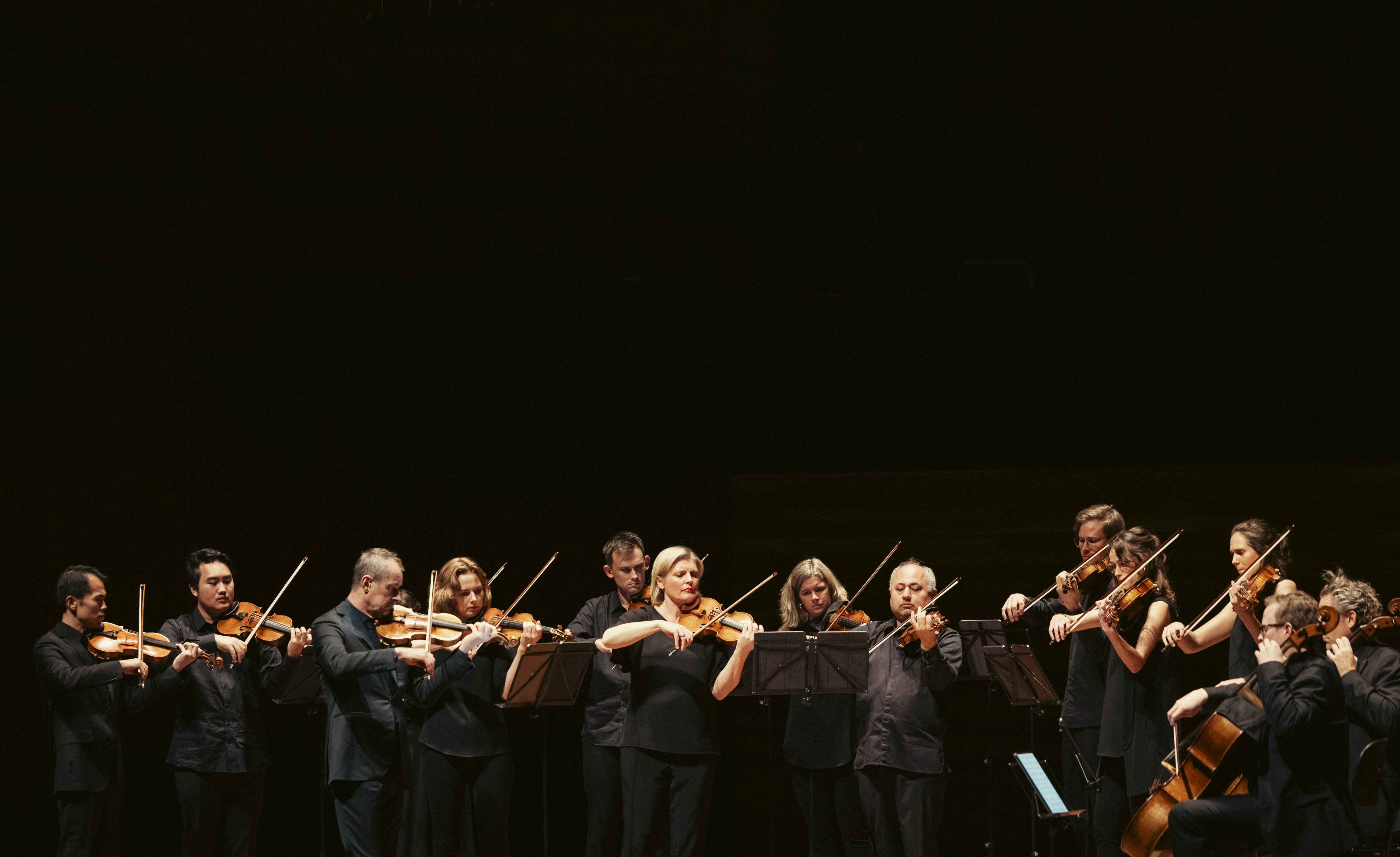
At the heart of From Winter’s Stillness – a collaboration between trumpeter Arve Henriksen, the celebrated group Trio Mediæval and the Australian Chamber Orchestra – is the coldly luminous beauty of Nordic landscapes.
Written by Fiona Wright
From Winter's Stillness is touring nationally from 25 July to 9 August.
When the Australian Chamber Orchestra’s Artistic Director Richard Tognetti first contemplated collaborating with Arve Henriksen and Trio Mediæval he knew, he says, that “we needed something really acidic” – something sharp and tart, almost caustic – to contrast with the purity of their music.
It didn’t take long for him to land on Alfred Schnittke’s Concerto Grosso.
“It might seem bizarrely contrasting,” he says, “but actually the music is perfect.” Schnittke is a self-described polystylist, bringing together in his music the ancient and the modern, pop, folk, the classical and the commercial. “Everything gets plastered on the walls,” Tognetti says. He adds, after a pause, “I like that.”
Tognetti sensed that Schnittke’s mixing of styles and eras and registers would speak to a sensibility that Arve Henriksen and Trio Mediæval share. They too, he says, are in their own way polystylists. And so the Schnittke Concerto – challenging, difficult and highly controversial in its time – is not a “foreign object” poking up against Henriksen’s and Trio Mediæval's work. It is, Tognetti says, “a portal into it, and a foil”.
I mention to Anna Maria Friman, one of the founding members of Trio Mediæval, that I am having trouble wrapping my head around the scale of the history, the sheer expanse of time, covered by the music in From Winter’s Stillness. Alongside a new commission – a world premiere – there are a number of hymns from Trio Mediæval's regular repertoire that are around 1000 years old. I say this, and Friman nods excitedly. “This is,” she says, “the very concept of the Trio Mediaeval.” It’s what she loves most about what the group can do.
What she means by this, she explains, is that there is real energy to be found in placing the very old and the very new side-by-side, in adding and combining epochs, moving in and out of different historical frameworks to see what happens in these kinds of combinations. Her favourite example of this is perhaps in the medieval music at the centre of the Trio’s repertoire, which begins with ancient monophonic pieces – which have only a single line of melody – and then suddenly opens into polyphonic work.
“It is hard to imagine the impression that must have made,” Friman says, “hearing that for the very first time.” Hard to imagine an audience used solely to monophonic hymns suddenly experiencing multiple songlines, interwoven and entangled. It must have felt like magic.
“I want the music we play to sound like we’re unpacking it for the first time,” Tognetti says. “It should always feel fresh.” It should always be experienced as new – as magic.
One way to go about this, of course, is by combination: the acid of Schnittke with the “purity, beauty and trueness” of Trio Mediæval and Arve Henriksen, the ancient with the entirely new.
Collaboration has always been central to the music of Trio Mediæval and Arve Henriksen, built into the core of their work. Collaboration, for them, is a source of energy. It is a means of exploring possibilities and pushing their practice in different ways. And – perhaps most importantly – it is a source of joy.
For Friman, the joy is in meeting and working with “kindred spirits”, in the way that working in collaboration allows a musician to be a part of something “much, much bigger” than themselves. “You almost become one instrument, one group sound,” she says. Everything else – your individual lives, careers, concerns – just falls away.
For Henriksen, the joy is in the different challenges that each collaboration brings, the way he has to learn each time how to “blend” his trumpet into the music. Each time, he says, “you get new sonic challenges” and you have to “lift yourself” to meet them.
But it is Friman who best describes the unique chemistry of collaboration. “You know your own charisma,” she says. “But you don’t know the other players’ charismas, or how they will meet.” There is so much room for the unknown, and unexpected.
Arve Henriksen and the Trio Mediæval have been frequent collaborators since 2006, when they first played together in a series of performances in Bergen, Norway’s second-largest city.
“Twenty years ago?” Henriksen asks.
“Yes, it’s 20 years this year.” Friman grins.
“So you see, it is a long-term relationship.” Henriksen deadpans.
The joke is this: Henriksen and Friman first met for this collaboration. They are now married.
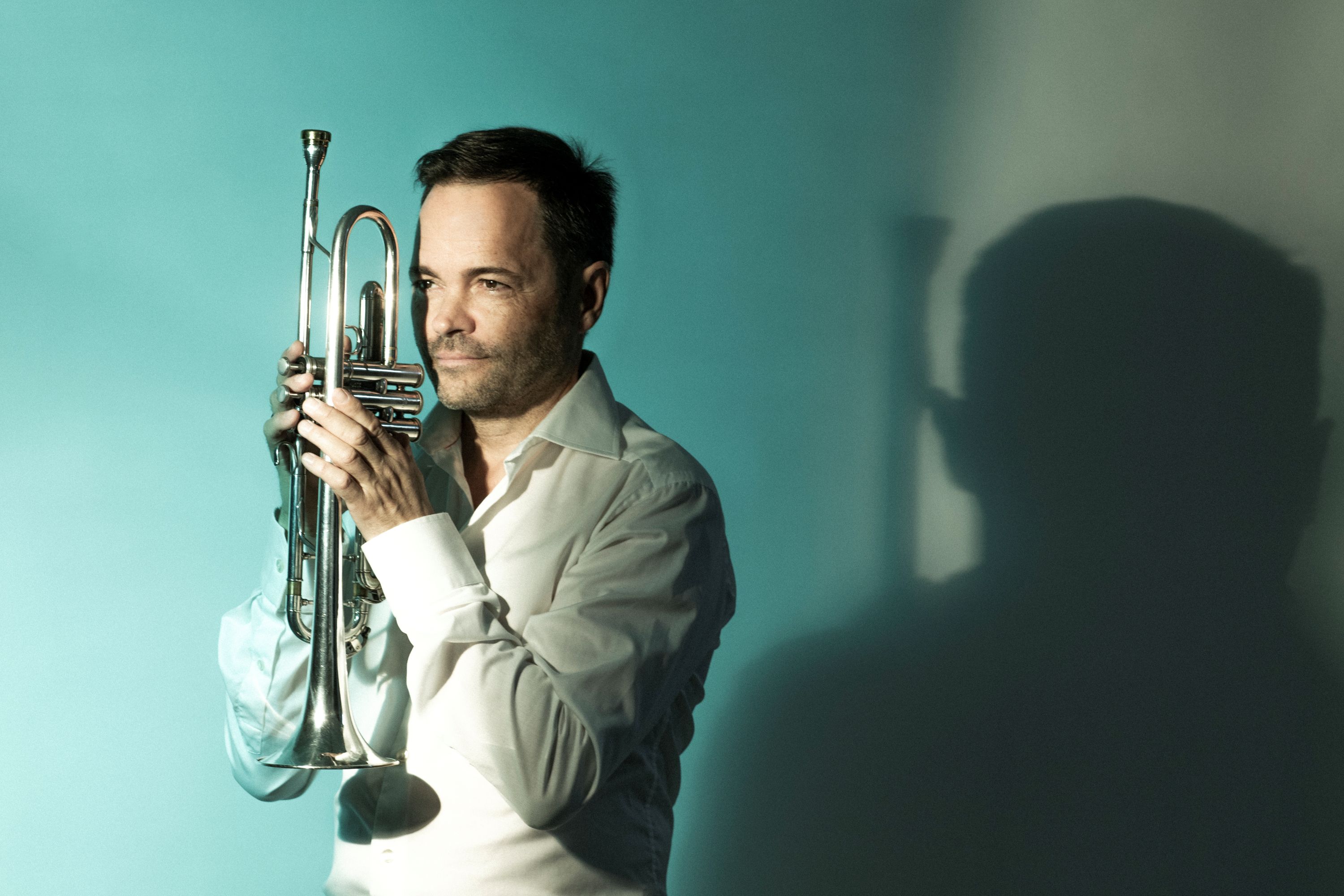
Arve Henriksen, by Julia Marie Naglestad
I don’t know anything at all about the new commission,” Tognetti tells me. Not yet – it is exactly one month before the first performance when we speak. That is, he adds, exactly as it should be. “It’s best to just let composers go about their business. If you stick your nose in, it won’t work.”
The new commission is a piece by Hildur Guðnadóttir, something of a contemporary superstar as far as avant-garde composers go. Guðnadóttir is known for her scores for film and television, with credits that include the HBO series Chernobyl, the 2019 film Joker – for which she won an Oscar, BAFTA and a Golden Globe, the first solo female composer to ever do so – and the 2022 film Tár, in which Cate Blanchett plays a fictional composer-conductor. “We were lucky to catch her between films,” Tognetti says. He knows the commission is a coup.
Tognetti is incredibly excited to “unwrap the present” of Guðnadóttir’s new work. Not knowing how things will turn out, or exactly what to expect of any program and any collaboration, is, he tells me, exactly how the ACO so often works.
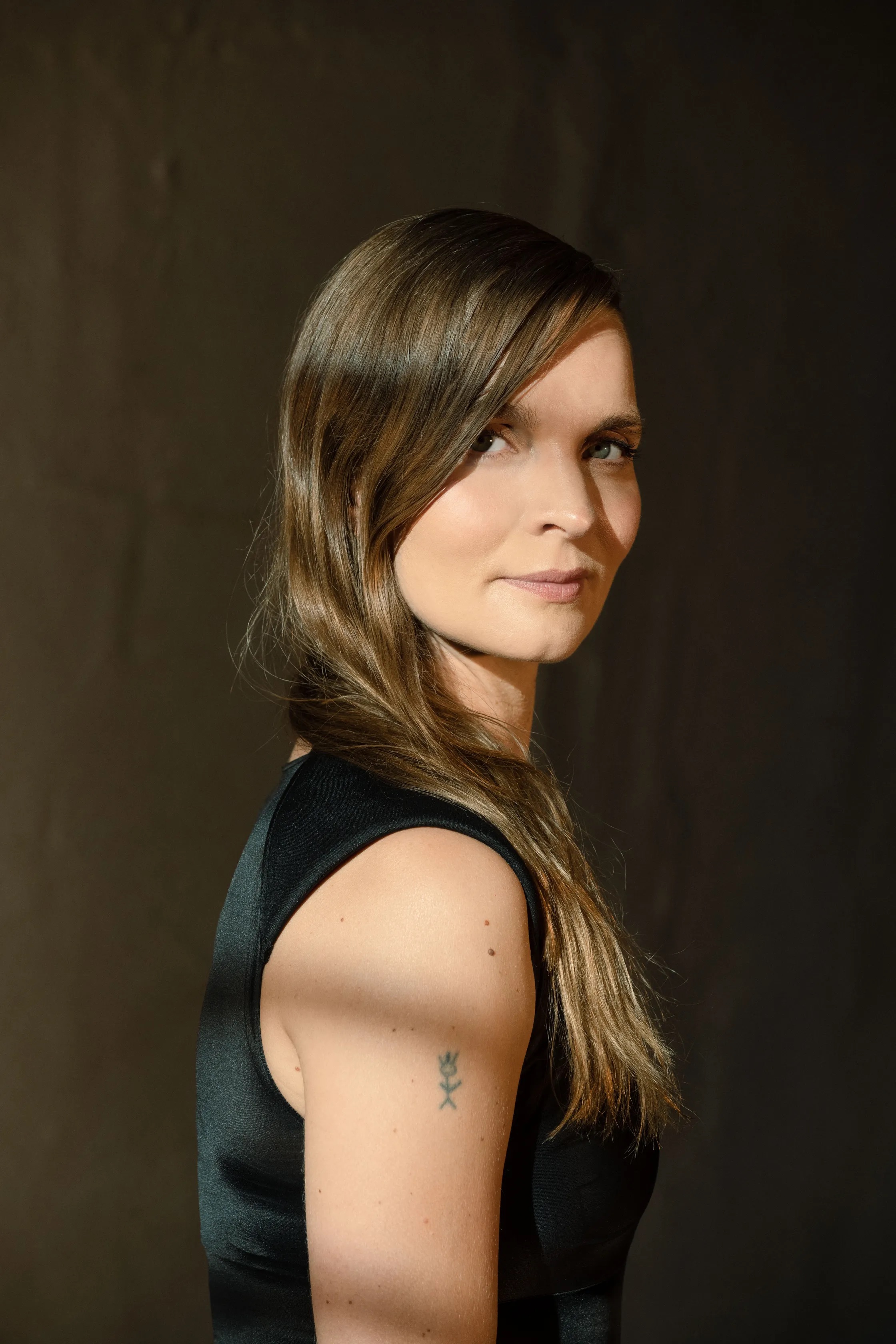
Hildur Guðnadóttir, by Camille Blake
“The music often evolves over the tour,” Tognetti says. This is part of what keeps the music fresh, keeps it sounding as if for the first time.
“You know,” says Anna Maria Friman, “no two of these performances will be exactly the same.” This is because Arve Henriksen is a jazz musician and improvisation is his métier – music as shifting and as happenstance as weather.
The sound that Arve Henriksen draws from his trumpet has been compared to the shakuhachi, the duduk – an Armenian double-reeded woodwind instrument – and the ocarina. All of these instruments are ethereal, fluting, breathy, sweet. The sound is often described as singular, entirely Henriksen’s own.
It’s no surprise that it surprises people, occasionally leaving them perturbed. During a run of concerts in Britain recently, Friman tells me, a woman was so disconcerted by Henriksen’s tone that she came up to him after one performance “to tell him that he needed to show people what a trumpet should really sound like.” Another pundit accused him of not being able to get the right sound out of the instrument. Both Friman and Henriksen are clearly delighted by these tales – and then Friman suddenly turns serious and says to me directly, “You have to listen. You have to listen to it to understand.”
Both Henriksen and Friman have a wonderful habit of adding to the other’s description of their own work. It’s not exactly finishing each other’s sentences, each other’s stories; rather, it’s more like an adding of emphasis or a filling in of context. Each time, they are making sure I understand the importance of the work the other person is doing, exactly what it is that is interesting, innovative, special about their music and their sound. Each time, they are making sure the other person doesn’t undersell themselves or speak too modestly. I’m not sure that they realise they are doing this. It is beautiful to watch: it too is collaboration, and profound.
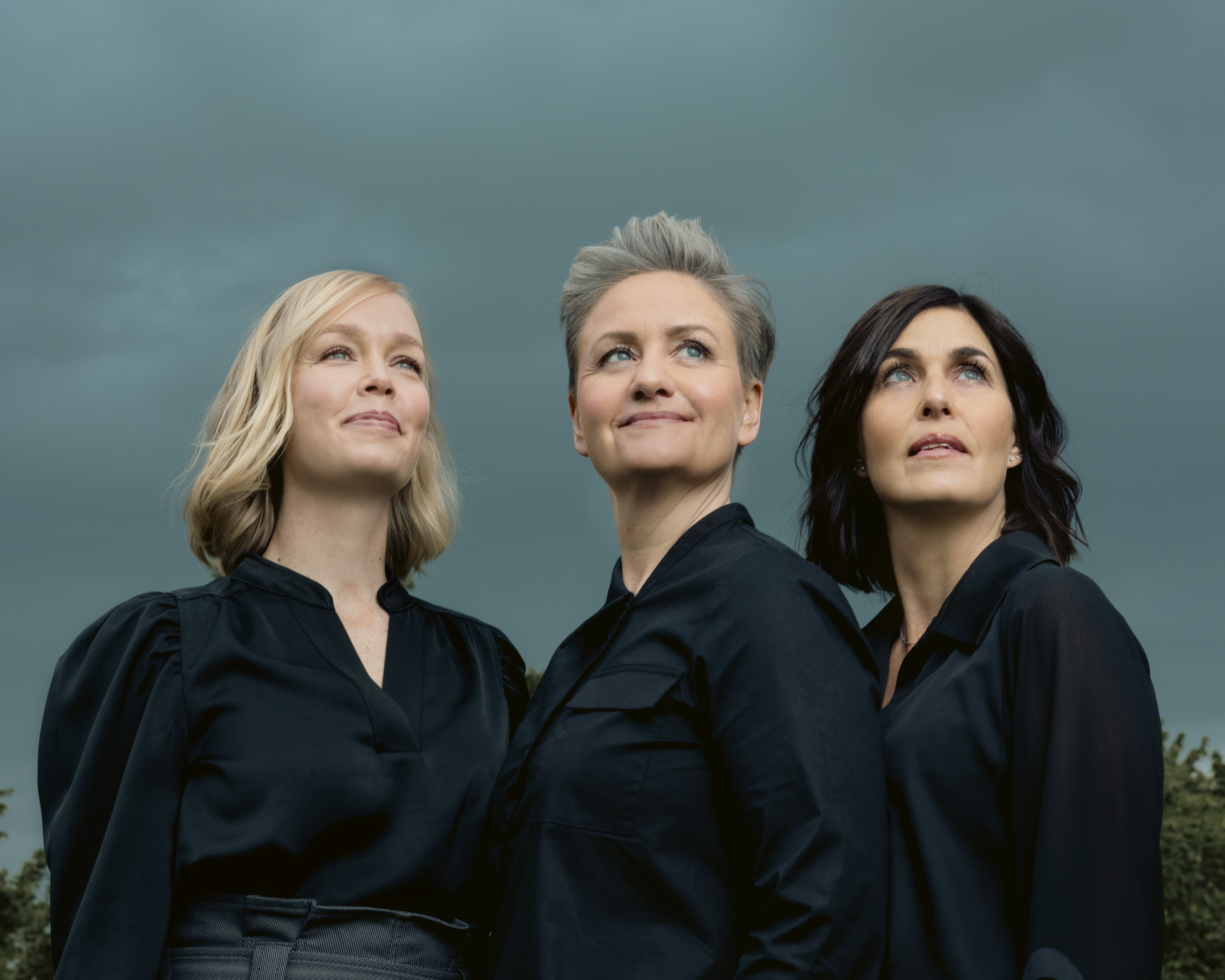
Image: Trio Mediæval's Ditte Marie Braein, Jorunn Lovise Husan and Anna Maria Friman.
But it is this particular instance that I keep thinking about in the days after we speak. I’m struck by the different tenor of Friman’s seriousness, its obvious and genuine esteem, by a sense that there might be something in the music that is beyond language, that speaks in a way that words can’t quite contain.
And so I listen to the music.
What I immediately think is this: Arve Henriksen’s trumpet sounds like a human voice. And suddenly, this unusual collaboration – a vocal trio and a jazz trumpet – makes perfect sense.
It is not a foreign object. It is part of the body itself.
From Winter’s Stillness is a program designed to take advantage of the strong sense of place – of time and of landscape – that is carried through so much Nordic music, and through the work of Trio Mediaeval and Arve Henriksen. To bring their sonic worlds, in their intensity and icy stillness, into contact with a new place, a new world with its own idiosyncrasies, its own commonalities and differences. The music in the program plays with ideas of harmony and dissonance, dynamic movement and meditative contemplation – but it always returns to this rootedness in place, an invitation to traverse the landscapes it evokes.
There is the steep-valleyed isolated bay Fljótavík in the north-west of Iceland that gives its name to the song by the rock band Sigur Rós, arranged here for the trumpet and strings, and the Icelandic volcano Eyjafjallajökull, whose 2010 explosion directly inspired Henriken’s original composition “Plume of Ash”, with its contemplation of deep geology and time. There is the island of Saaremaa, onto which the Estonian composer Tönu Kõrvits transplants ancient myth and folklore. All of these are starkly beautiful, coldly luminous places carried in the music, across which the listener will be taken.
And then there is the work of Hildur Guðnardóttir, and the “extraordinary” soundscapes that are always at its heart. Guðnardóttir’s music, with what Tognetti describes as its “dark textures” and “minimalistic, hard ambiance”, is always evocative of place and space, of everything that shimmers and hums and is unsettled within a landscape. It is music that “eschews easy melody” in favour of texture, angularity, density: it is another portal, another foil.
Arve Henriksen talks about the landscape in which he was raised – and which inevitably informed his approach to his music – as the kind of landscape that is emblematic of the “sound worlds” and sensibility of From Winter’s Stillness.
Henriksen grew up in a small village on the west coast of Norway, a region known for its rugged beauty, its glaciers and fjords, vertiginous valleys and mountains. It was here that he first started playing music as part of the local marching band – there is, he explains, a strong tradition of marching bands in Norway, and all five of his siblings played in the troupe as well. That it was the trumpet he picked was “pure coincidence,” he says. “My father had a trumpet in the cupboard. So that was that.”
The west coast of Norway is also home to a tradition of folk singing that occurs up in the mountains, Friman explains, where cowherds call in their animals through song. This song she describes as resonant, as beautiful, “a penetrating, high sound” that echoes across the valleys.
“It gets lonely up there,” she says, “but you can sometimes hear people respond from kilometres away.”
I keep thinking about this music that finds its listener kilometres away, that traverses great distance and connects across them, as possessing some strange synchronicity with what From Winter’s Stillness sets out to do. That there is something about this music born of traditions of place resonating elsewhere, something about its ability to speak despite great difference, despite the different landscapes of our lives and hearts.
This kind of rugged, weather-tossed landscape, Henriksen says, has a psychological impact on the people who live within it. “You can’t avoid nature,” he says. You have to live according to what it dictates, from day to day and season to season. You have to concede to its greater power: the fact that it demands sometimes that we bunker down.
I keep thinking, too, that so much of our experience of landscape – not only those landscapes that are vast and rugged or otherwise sublime – is an experience of intensity, about connection with something bigger, older, grander than ourselves. Something other, that makes us reconsider our very selves, as well as our position in the world. Something that might slow us down and hold us for a moment, suspended and still.
From Winter's Stillness is touring nationally from 25 July to 9 August.