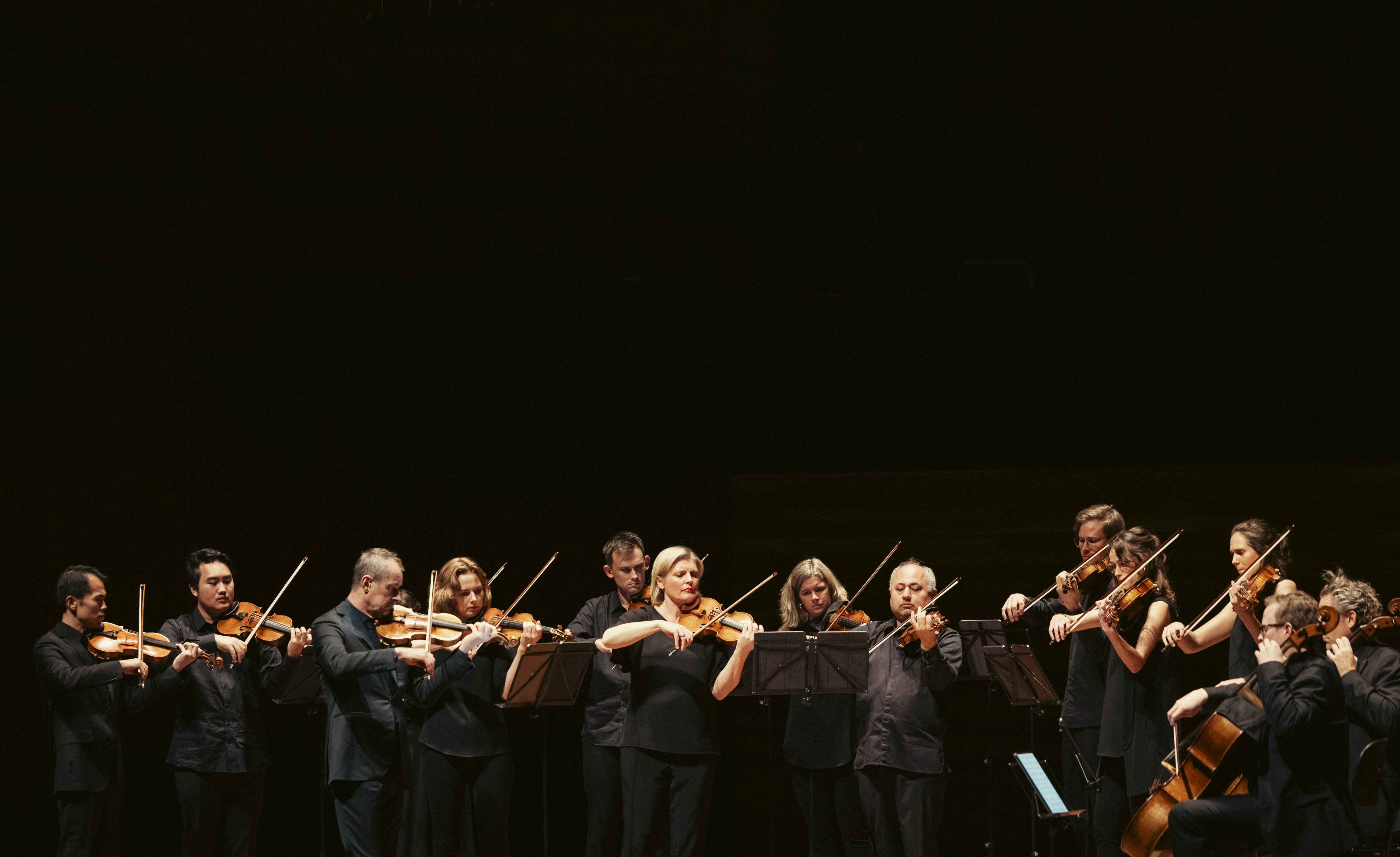
Below, an excerpt from our Isles of Light program essay by Kate Middleton.
Lawrence Power is interested in the composer-viola players of today, such as his friend and collaborator, violist and composer Garth Knox, who consciously extends the music of the viola, making new histories. As an in-demand soloist and caretaker of an extraordinary instrument, Power takes as an exemplar the cellist Mstislav Rostropovich. “Without Rostropovich, you wouldn’t have all the Benjamin Britten works, Shostakovich, Prokofiev, Myaskovsky, Lutosławski…” says Power. “So much cello repertoire exists thanks to that one performer. If you look at history, there are these key people who commissioned works or were a driving force behind just getting great pieces written.”With Rostropovich in mind, Power formed the Viola Commissioning Circle, with which he is in the process of commissioning 10 viola concertos over 10 years. The Commissioning Circle has already commissioned concertos and other works from composers including ESA Pekka Salonen, Thomas Larcher, Thomas Ades, Magnus Lindberg, Cassandra Miller, Anna Clyne, Liza Lim, Erkki-Sven Tuur, and Olli Mustonen amongst others.
This dedication to new work feels natural to Power: “It’s a part of the DNA of my instrument, I guess – that we’re dealing with new music all the time.”
That figure of speech, “the DNA”, again speaks to the sense of a living instrument and living repertoire. It’s also a great reminder of the impact ensembles such as the ACO can have: making relationships with composers and committing to the performance of new works means that the Orchestra’s life is never static. I think of new works as enabling listeners to hear the old with fresh ears. New music can move in any direction. It can offer an “extraterrestrial new language” or it can look back at history and recontextualise it. Power is open to many different approaches: as a performer he has to be flexible, sometimes “inventing interesting ways to play”, at others finding ways to make new music work on his instrument. What he emphasises is being open to many different forms of collaboration: having “a beautiful spectrum of music being written for me”.
He describes this program as a snapshot of British music across the ages. As we talk about what is British about this program, he acknowledges that there is no one quality that characterises the music. While the word “pastoral” is often invoked in discussions of British music – especially that of composers such as Ralph Vaughan Williams – it is a word that Power resists and complicates. “When you dig into the whole nature of pastoral music, it’s an interesting conversation because it’s actually quite dark. It’s not pretty birds tweeting.”
Instead it’s the resonance and connection to history that draws Power to this music. Ralph Vaughan Williams looks back to Thomas Tallis and to English folk song to create a sense of continuity in British music: his Fantasia on a Theme by Thomas Tallis is one of the composer’s best-known works. Vaughan Williams was often drawn to the English Renaissance and to folk songs as he sought to incorporate tradition into his emerging oeuvre. In this conscious decision to look at that tradition, Vaughan Williams shapes the listener’s perception of it. Power’s gathering of works around the famous “Fantasia” places these works in conversation with each other, inviting new resonances.
The program’s “English Mixtape” traverses ground from Henry Purcell to Kate Bush, both important proponents of British song, looking to forms of continuity with tradition. Edward Elgar, whose “Nimrod” variation from the Enigma Variations is always played on Remembrance Sunday, has “a very specific connotation for English people”, and appears in the Mixtape on the program, as does music by poet and composer Ivor Gurney, another proponent of British song.
Herbert Howells, an organist and composer, is represented in this program by his early, lyrical Elegy for Viola, String Quartet and String Orchestra. A composer such as Elizabeth Maconchy, Power says, has been often “overlooked”. Maconchy’s music, he notes, is very inspired by Igor Stravinsky and often looks to Eastern European composers such as Béla Bartók and Bohuslav Martinů, but she writes from her time and place. Her 1952 Symphony for Double String Orchestra gives “maybe not specifically a British feeling, but it does give a 1950s London feeling”. In that specificity, expressing the attitude of a time and place, each of these pieces contributes “its own unique little story” to the whole.
Perhaps the program forms not so much an overview as an itinerary. At the centre of the concert is the Australian premiere of Garth Knox’s Viola Concerto – co-commissioned by the ACO – another entry in the viola repertoire. Power praises Knox’s work as violist and composer, as well as his engagement with musical history. A former member of Pierre Boulez’s Ensemble InterContemporain and Irvine Arditti’s Arditti Quartet, Knox performs on not just the viola but also the viola d’amore, an instrument whose repertoire crosses the baroque and modern periods.
“He has been at the forefront of new music for a long time,” says Power. “He’s a Renaissance person: he’s very connected to his role in history. He composes, he improvises – he is aware of the role of a musician historically.” Power says that it is a joy to play Knox’s music, noting that it “lies beautifully” on the instrument.
This work is inspired by Samuel Taylor Coleridge’s visionary poem The Rime of the Ancient Mariner. The poem is present in the music not just as inspiration – as a tone poem or programmatic music may be – but extends to the staging of the work. Power tells me that the orchestra will be reconfigured, sitting in the shape of a boat. As for the famous “albatross about my neck”, that is one of the concerto’s “surprises”.
I am excited to see how Knox allows Coleridge’s poem to guide the music through narrative flourish, musical symbolism and the use of the stage. The Rime of the Ancient Mariner has inspired many artists across different art forms. The poem’s seascape, by turns tumultuous or glassy and still, has enormous scope for musical interpretation. The senseless crime at the centre of this narrative – the killing of the albatross that led the mariner’s crew out of Antarctic waters and that has become a cultural image of great power – bears cosmic punishment. Power describes having “a detuned viola wrapped around my neck” and I imagine music suddenly unable to take flight in any direction.
In the poem, the crew’s fate is death, while the mariner’s punishment is “the nightmare life-in-death”, and the ongoing task of recounting his story. In his Viola Concerto, Knox translates the work into a new form, using recitation and musical devices to tell the tale. In performance, Power is interested in how to reimagine the presentation of classical music: for this Viola Concerto they are adding a “fluid dimension to the staging”, with players actively moving. “I think that could be quite exciting for the audience,” he says.
It is this reimagining of how music can be configured for contemporary audiences – each piece full of new possibilities – that makes the ACO the perfect crew with whom to embark on the next voyage.
Isles of Light | Touring Canberra, Melbourne, Sydney, Brisbane and Adelaide, 13 - 23 June.
This is an excerpt from our program essay for our national tour, Isles of Light.
Kate Middleton is an Australian poet and critic. She is the author of the poetry collections Fire Season, awarded the Western Australian Premier’s Book Award for Poetry in 2009, and Ephemeral Waters, Passage and Television (Giramondo). She has written widely for Australian literary publications and worked in collaboration with artists and musicians. In 2020 she was runner-up for the ABR’s Calibre Essay Prize. From 2021 to 2026 she was the poetry editor for Island.