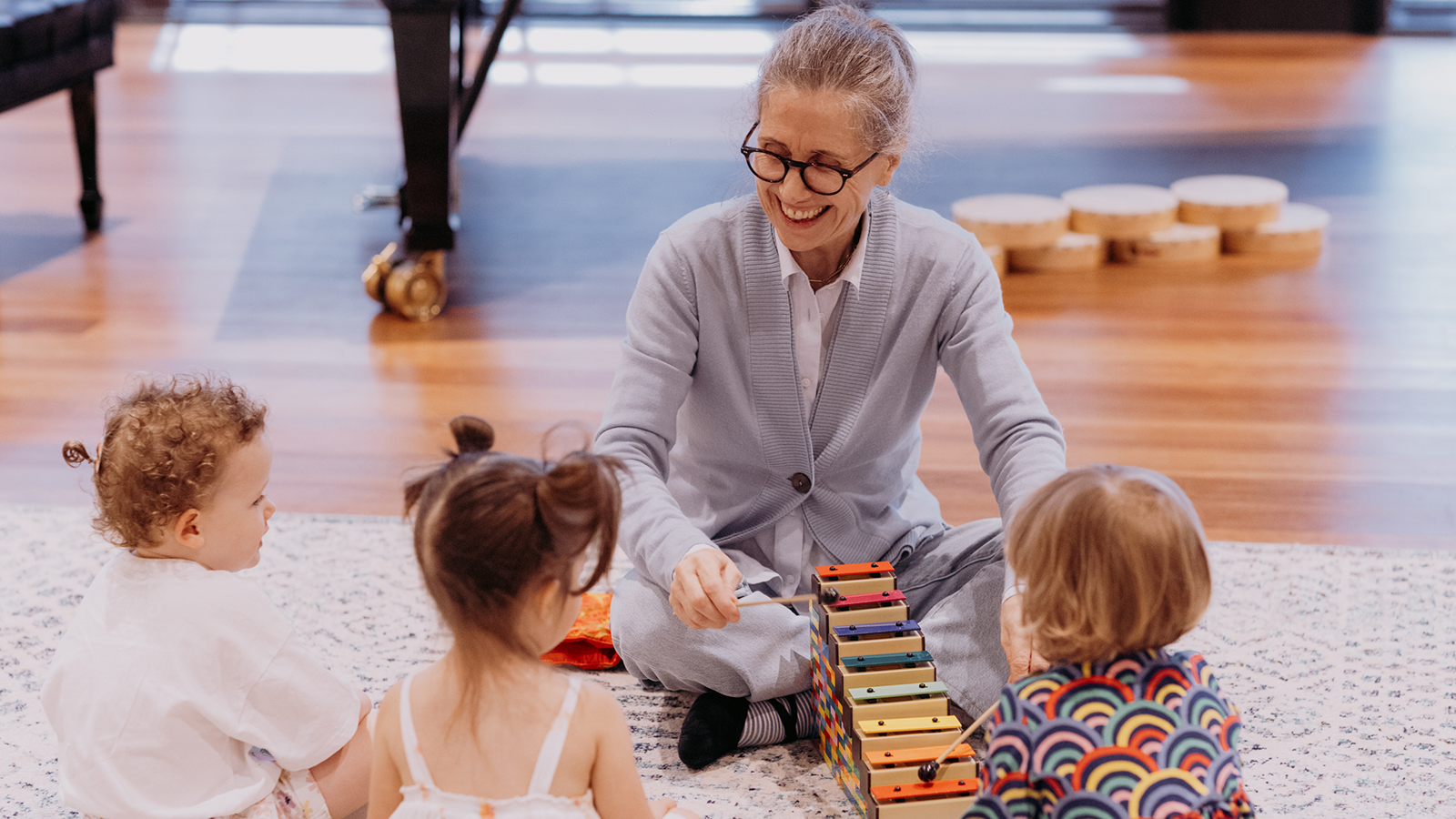
We spoke with Simona Green, the ACO's Music and Movement educator, about how families can bring music into their homes and lives.
Below, a guide inspired by Green’s insights to help encourage musical curiosity and connection in their family’s day to day rhythm.
Why music matters
Music engages the whole child – mind, body and emotions. When a child listens to a melody, taps along to a beat or sings, they’re working on the foundations for language, motor skills, emotional understanding and social connections. Humans have sung to their babies in cultures across the world for dozens of generations, and a parent’s voice helps to deepen connection on cultural, emotional and sensory levels. Green explains that beat and rhythm are perceived unconsciously, and that singing to a child helps to develop emotional patterns, especially when repeated. “The tone of the song can excite or relax, reassure or scare, surprise or reenforce,” she shares.“ And of course, words, stories, and traditions can be learnt through songs.”

Simple Ways to Incorporate Music at Home
Green emphasised that music for young children doesn’t need to be structured or complicated, and all exposure works to help later understanding. “Experiencing with the body first will help the child to better understand later abstract concepts connected to music.”
Some of the most developmentally rich experiences are the simplest ones. Here are a few ways to get started at home:
1. Sing Throughout the Day
Singing can be reframed as a musical conversation, turning everyday events and routines into mini melodies.
- Sing during play
- Sing their name.
- Sing instructions ("Let's put your shoes on, shoes on, shoes on...")
Your child will naturally absorb rhythm, phrasing, and emotional expression from your voice.
2. Use Your Body as the First “Instrument”
Before children can understand abstract musical ideas, they understand movement. Their bodies help them experience beat, rhythm, flow, and energy.
Try:
- Bouncing your child on your knees to the rhythm of a song
- Tapping gently on their hands, knees, or back
- Lifting or “dropping” your child in time with a melody’s rise and fall
- Clapping, stomping, spinning, jumping, or swaying together
These activities help little ones build gross motor skills, coordination, and emotional connection, all while grounding them in musical concepts they will build on later.
3. Make Use of Action Songs
Action songs combine music, movement, and language. Think of songs like “If You’re Happy and You Know It” or “Open, Shut Them.” Green recommends finding songs or developing musical moments that reflect your child’s interests, such as animals, flowers, trains, rainbows, and so on.
Action songs work to:
- Boost physical coordination
- Strengthen listening skills
- Support language development
- Make learning playful and social
Action songs are perfect for burning off energy and inviting kids to move with purpose and joy.

But What If I’m Not Musical?
Good news: there's no requirement to have perfect pitch or be a classically trained musician to bring music to your world. If singing feels intimidating, you can still foster a musical home environment. Simply listening and moving together, without screens, is especially valuable, says Green: “I would suggest interacting with an auditory experience more than a visual plus sound one. The child should be free to follow his or her own inspiration and creativity flowing from the music.”
Try:
-
Playing nursery rhymes, folk songs, or classical pieces, both for active and passive listening
-
Attending live community music events
-
Chatting about what you hear - “Is this music fast or slow? Loud or soft?”
-
Using your speaking voice musically
You can make your everyday speech expressive:
-
High vs. low
-
Fast vs. slow
-
Gentle vs. loud
-
Grumpy, happy, shy, surprised
These small vocal games help children explore pitch, emotion, and storytelling, all important foundations for musicality.

Family Music Time: Simple, Fun Ideas
Music doesn’t need to be scheduled, but having intentional moments together can create beautiful traditions and connections. Green explains that inventing music together can be especially meaningful: “Helping the child to make up his or her own little song, or sound story, is perhaps one of the most exciting ways to connect him or her to the wonders of the art.”
Try:
-
Dancing together in the living room or backyard
-
Keeping the beat on your legs, the floor, or with household rhythm instruments
-
Singing songs that match your child’s interests, like animals, trains, flowers, rainbows, or imaginary creatures
-
Making up your own songs together based on events, routines or your child’s interests
Creating sound stories or soundscapes, like:
-
rainstorms building and fading
-
bees buzzing and rabbits hopping
-
dinosaurs stomping through a forest
-
trains chugging up a mountain
-
spaceships whooshing into space
This kind of imaginative play strengthens creativity and helps children express ideas in different ways, which especially helps children who struggle with verbal communication.
When children make music, they’re learning skills, expressing, discovering and connecting. Green's insights and ideas show how accessible and meaningful music can be in the flow of daily family life. By inviting sound and movement into your home, you offer your child a canvas for creativity and a language for emotional and social development.
If you're interested in joining Music and Movement at ACO On The Pier in Sydney,
read more here or join the waitlist at the link below.