Five feet tall, stout, bespectacled, smelling of tobacco – Little Mushroom, his friends called him, in his shabby brown coat under his high, round, brown hat. Always, rolls of music stuffed into his coat pocket – all his life, inexhaustibly, the music poured from him. When he composed, said a friend, he looked like a sleepwalker. His eyes shone as though made of glass, he clicked his tongue. He said, “When I finish one piece I begin another.”
In 1797 in Vienna Franz Schubert was born – the 13th child, fourth to live past infancy. His father was a schoolmaster, a child of Moravian farmers. His mother too came as a child to Vienna. Her father died when they arrived. Fourteen years old, an orphan, she worked as a housemaid before her marriage. Schubert’s brother, 12 years older, started teaching him piano. “Franz told me, a few months after we began, that he had no need of any further instruction from me.” The father started Schubert on the violin. Their pianoforte was a poor thing. Schubert's friend took him to a pianoforte warehouse; he played there, among silent instruments.
His father took him to audition at the Imperial Seminary; the Italian composer Antonio Salieri was there. Schubert got up in his blue-white coat. The children laughed – “He must be a miller’s son!” – but fell silent when he sang. He started in second violins; at 12 he was conducting symphonies: Haydn, Mozart, Beethoven. On summer nights crowds gathered under the open windows, listening.
Schubert was hungry all the time. “You know from experience that we all like to eat a roll or a few apples sometimes,” he wrote to his brothers. Schoolmates remembered him as the only student allowed to walk out the gates. He took lessons in composition from Salieri: songs, opera, masses, string quartets he played with his family.
When his voice broke the school asked him to work on his Latin. “I came into this world to compose and for no other reason.” He went back to his father's schoolhouse and taught six-year-olds. A bare room, the only object within it a pianoforte that his father had given him “from the joy of his heart”, when Schubert’s Mass was played at Lichtenthal Church. Taking his students for walks, arms behind his back, Schubert moved his fingers in air, composing silently. The children interrupted him and he lost an idea; he thumped them then. Still the music poured from him.
Schubert lived in a time of unrest and repression; he was trying to make things new ... In his music every single moment is tense with emotion, and each quick-changing emotion must be felt to be played.Richard Tognetti
In March 1824, the knowledge that death was close to Schubert awakened not simply grief but ambition. At school he confided in Josef von Spaun. “In my heart of hearts, I still hope to be able to make something of myself – but who can do anything after Beethoven?” Now his letter to Leopold Kupelweiser set grief and ambition side by side:
Imagine a man whose health will never be right again ... Imagine a man, I say, whose brightest hopes have been destroyed, for whom the happiness of love and friendship means nothing but pain...
Then he turns back to his work:
As for songs, not much that’s new; instead I’ve tried my hand at instrumental works. Two quartets for violins, viola and cello, & an octet... I’m hoping to pave my way to a grand symphony. Everyone in Vienna’s saying Beethoven’s giving a concert, his new symphony, three pieces from the new Mass, and a new overture. God willing, next year I plan to give a concert like that.
A symphony, a concert like Beethoven’s – Schubert’s posthumous fame obscures the courage of those assertions. At that time, even among friends he was considered a peerless master of popular works, not a maker of masterworks. But in 1824 he had a sense of time running out – and a new chance to stake his claim: the virtuoso violinist Ignaz Schuppanzigh had returned to Vienna.
Count Ferdinand von Troyer – clarinettist and chief steward to the archduke Rudolph – asked Schubert for something along the lines of Beethoven’s septet for winds and strings, first performed in 1800 when Schubert was three. Clean, elegant, bright, beloved: Beethoven was sick to death of it.
Beethoven’s septet had clarinet, horn, bassoon, violin, viola, cello, double bass. Schubert added a second violin. That March he worked on his Octet obsessively. His friend Moritz von Schwind tried to visit: “If you call during the day he says, ‛Hello, how are you? – Good! – Yes, fine,’ and goes on writing.”
Schubert kept Beethoven’s six-movement structure: a slow beginning, clash of minuet and scherzo. He kept the joy. But at the opening of the first movement, with a sustained note he made a shimmering path of sound lead from the performance chamber out into some dream-like realm as sudden and candid as a fairytale. He played with variations on a theme from a song in The Friend from Salamanca: “Nestled under a bright canopy of trees.” In this woodland realm the music dances – and in those yearning distances awakened by the horn’s echoing calls.
Rich from his concert, Schubert took a friend to hear Paganini. People said the devil taught Paganini to play, that he’d perfected his art in a prison cell playing on a one-string violin. Raven-haired, bone-thin, dressed in black, Paganini astounded not only through virtuosity, but new forms of composition: capriccios that impersonated moods, weather, church bells, daemonic laughter. That winter Schubert composed the final 12 poems of Winterreise and his Fantasy in C major for violin and piano.
The opening of Schubert’s Fantasy sounds like the beginning of the world. Over a roiling piano, the violin’s long notes extend like light in darkness. From that elemental beginning, the Fantasy unfolds in contrasting movements, loosely linked – sometimes as ornately delicate as frost flowers, sometimes with such runs of notes that music seems an element to be hewn as well as wrought.
Wildly original, the Fantasy is also prodigiously difficult. Schubert composed it for violinist Josef Slavík and pianist Karl Maria von Bocklet. Chopin called Slawjk a “second Paganini”. Bocklet was another virtuoso, and in the Fantasy Schubert makes the piano work like an orchestra.
The Fantasy is like a poem, a marvellous poem, unfolding like Coleridge's poem “Kubla Khan: or a Vision in a Dream” through chains of sound like radiant images.Richard Tognetti
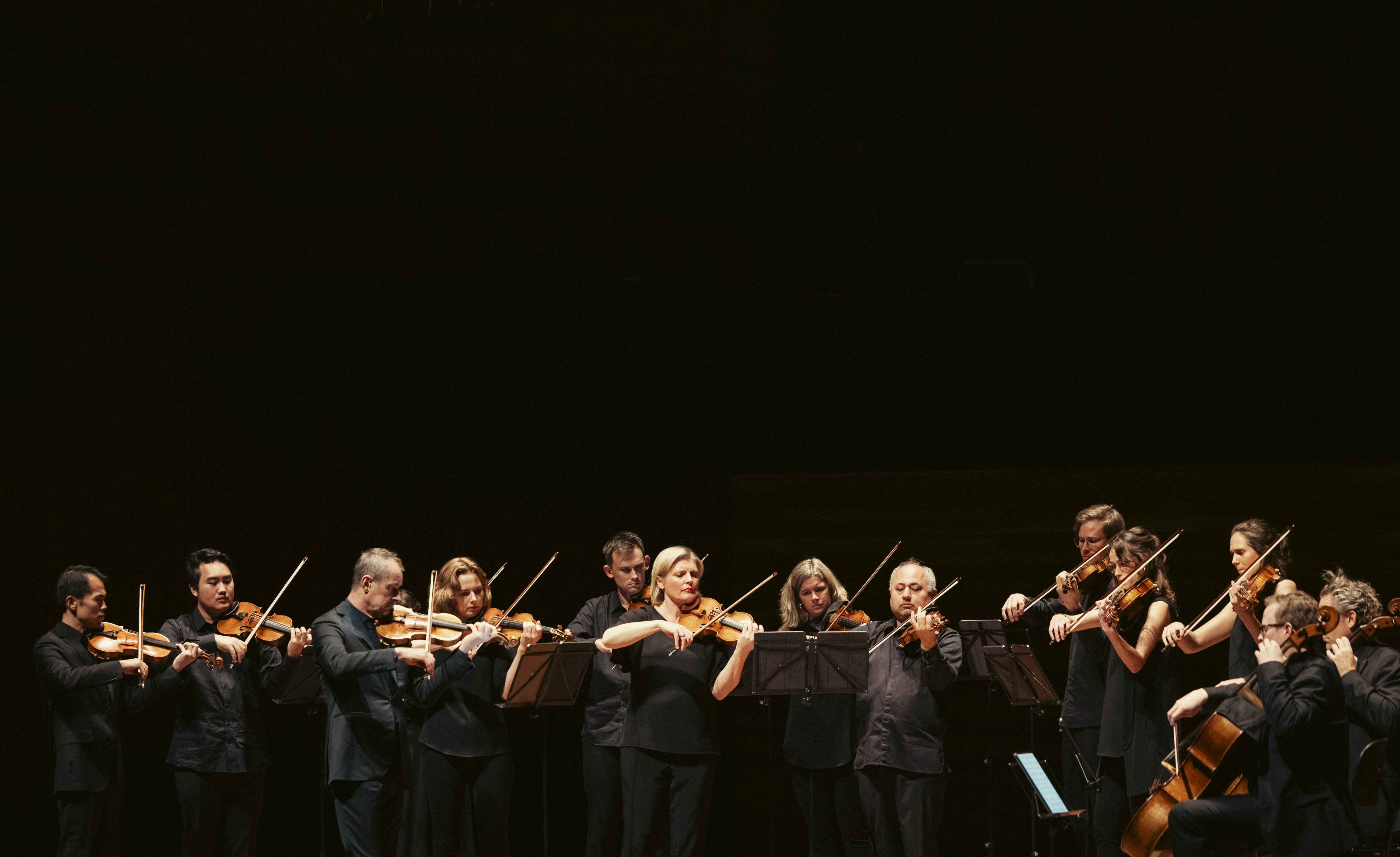
With that in mind, for this concert Richard Tognetti has arranged the piano part for an octet. In doing so he reveals the orchestral range Schubert allocated to piano and illuminates the Fantasy’s links with the Octet and the String Quintet in C major, the masterpiece Schubert wrote two weeks before he died.
Schubert hiked to Eisenstadt and sat by Haydn’s tomb. Back in Vienna, he ordered a fish dinner. At the first bite, he threw down his fork. He’d been poisoned, he said. After that, he took only medicines. He moved to his brother’s house. He had typhoid fever. In his deliriums he sang; in the intervals he sat up correcting proofs of the second part of Winterreise.
On the eve of Schubert’s death, the doctor reassured him that soon he’d be well. Schubert felt for the wall and said, “Here, here is my end.” He wanted to know why his brother had shut him in a room underground with Beethoven. He asked his brother to bury him by Beethoven’s tomb.
Schubert's Fantasy & Octet | Touring Newcastle, Canberra, Sydney, Adelaide, Wollongong and Melbourne, 14 - 30 May.
Lisa Gorton lives in Melbourne, Australia, and writes poetry, fiction and essays. A Rhodes Scholar, she holds a doctorate on the poetry and prose of John Donne from the University of Oxford. Her novel The Life of Houses (Giramondo) was awarded the Australian Prime Minister's Prize for Fiction. In poetry, her awards include the Philip Hodgins Memorial Medal, the Premier’s Prize for Poetry and the Wesley Michel Wright Poetry Prize. Her poetry has been widely anthologised, including in the Turnrow Anthology of Contemporary Australian Poetry, the Poetry Magazine edition of Australian Poetry and The Uncollected Animals. Her poems have been set to music in Michael Bakrnçev's composition The Storm Glass for the Canberra Symphony Orchestra. Her fifth poetry collection, Mirror Landscape: New and Selected Poems, appeared from Giramondo Publishing this year.