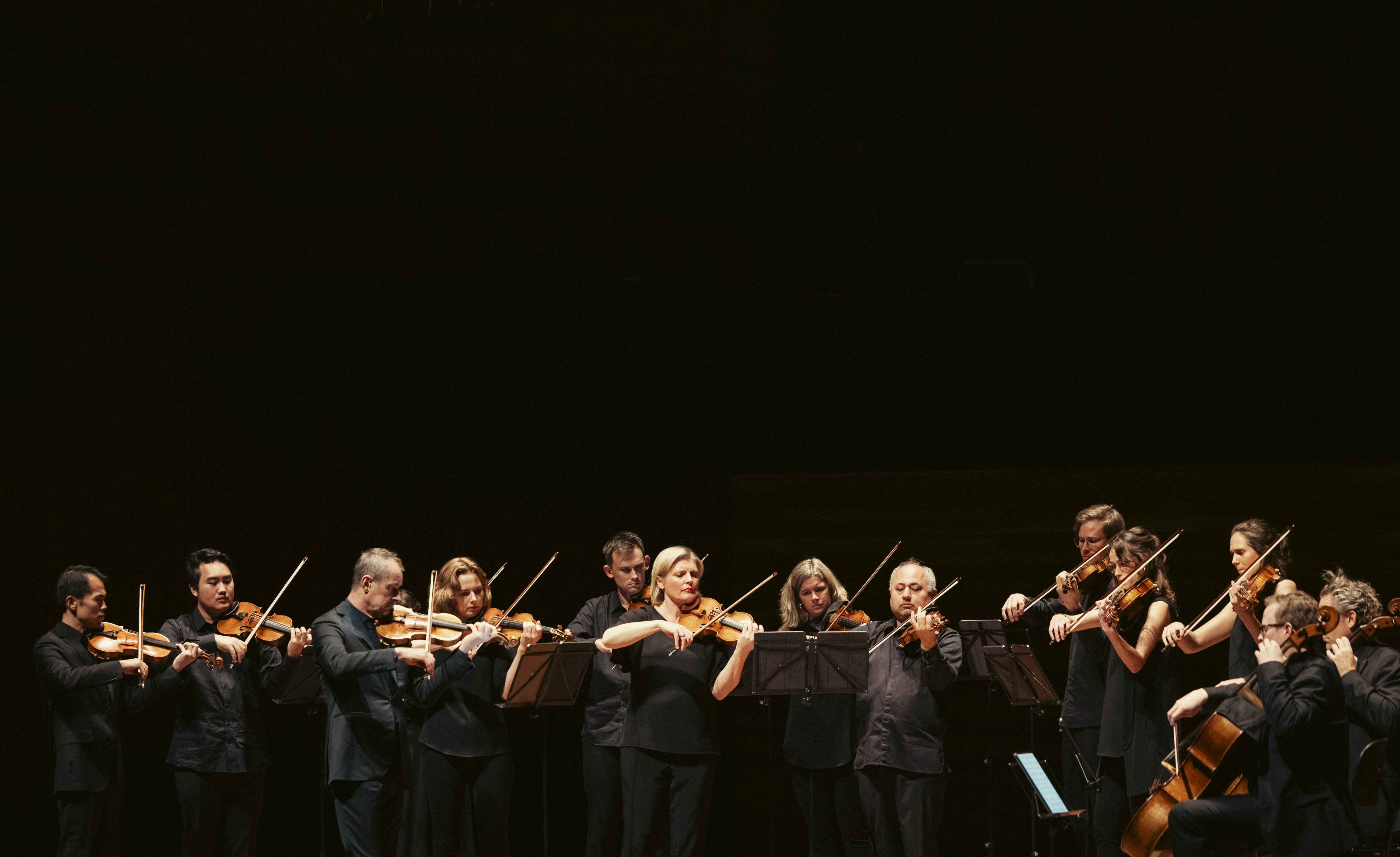
Below, an excerpt from our Isles of Light program essay by Kate Middleton.
“This is the first time I’ve worked with the Australian Chamber Orchestra.” British violist Lawrence Power tells me, as we discuss the several hats he’s wearing for this program. It’s an exciting prospect as a first collaboration: in developing a program for this ensemble, Power has the opportunity to curate music that reflects the way his career has grown as soloist, commissioner of new works, musical historian and practitioner.
As director, violist and violinist, Power offers a “love letter” to British music in Isles of Light, a program that crosses centuries.
What comes out often in our conversation is a sense of Power’s prevailing interest in history. We discuss how British music integrates its own history, for instance, when composers look back to earlier British works. There’s the historic provenance of his own instrument, and Power’s embrace of the viola’s repertoire in its full historic range, as well as his desire to extend it through his work with new music.
The viola, he says, is his “mother tongue”. Power is well-versed in the existing language but also wants to make sure that he coins new vocabulary for the instrument, and for the orchestra that accompanies it.
He didn’t initially choose the viola as his instrument. At seven, he was tall for his age. “They ran out of violins, and they gave me a viola instead,” he says. “So there was no romantic story”. I enjoy reflecting on the happenstance of that scene. Power doesn’t come from a family of classical musicians: “We didn’t even know what a viola was then, to be honest with you.” As he came to embrace the instrument fully, he fell in love with it, developing an “obsession” with the viola and its repertoire.
There is no such thing as a “standard” viola. The viola is not simply a bigger violin, but rather an instrument that has changed at different moments in its history – in contrast to the violin, which has held the same dimensions for centuries. This variability, I learn, comes from the fact that acoustically “perfect” dimensions would result in an instrument too large to hold under the chin.
Because of the non-standardised design, each viola is truly different, containing within its body a balance between playability and depth of tone.
Power’s instrument for this concert is a 1580 Brothers Amati viola. From one of the most famous instrument workshops in history, the Amati has a pedigree of which he is conscious: Power refers to himself as its “temporary curator”. The word “curator” is canny. Just as a gallery develops a cultural aura through the art it displays over time, this instrument has its own aura. It was previously played by German-American violist Walter Trampler, who like Power was a champion of new music, commissioning many new works over his career.
This viola is an old instrument in whose body new music accumulates. Noting the ACO’s collection of historic instruments, Power marvels at the beauty of their craftsmanship and the privilege of being entrusted with one of them for a time.
A viola such as this, Power notes, is a living instrument. Its wood breathes. A big part of travelling around as a string player, he says, is understanding the way the instrument responds: for example, “when you go to a humid place, things feel very different.” The instrument reflects its environment and both the instrument and the player must adapt. While the viola has this changeable quality, it also has a continuity that appeals to Power: “I play in all these beautiful places, and it’s the same invention, without amplification.” As the instrument travels with him, he writes new performances into its history.
In the past decade, Power has also regularly played the violin. He doesn’t see a dissonance in championing both. If the viola’s form is notable for being changeable, the violin’s constancy is equally remarkable. It’s “two pieces of wood glued together with some strings at tension, and a little bit of wood inside to keep the tension”. Moreover, the violin is “acoustically correct, according to all sorts of Pythagorean measurements of sounding string lengths”. He suggests this sounds geeky, but it is just this sort of detail that captures for me what is so interesting about playing both instruments at such a high level.
In picking up the violin, Power feels a continuity with the musicians of the past. The specialisation of playing only one instrument is, he says, a very recent fashion. In the past, a musician such as himself would “have to play the violin and the viola at least, and then maybe even play the viola d’amore”. The desire to move between instruments is born both of a connection to the historical role of musicians and of the wish to be “a useful musician”. It is also, I suppose, a way to never grow restless.
With these two instruments, Power is able to find great variation, constancy and changeability. The violin, he says, “sings so beautifully – it has that in its DNA somehow”. The viola, on the other hand, is often said to be close to the human speaking voice. “Every viola has a slightly different timbre, a different voice,” he says. “One viola might be always quite bass-like. Another viola might be more contralto. And even though, within its voice I can play everything at the top that the violin could play, more or less, or what a cello could play, there’s this beautiful pathos to the viola. There’s something in the viola, maybe this little bit of compromise, that makes it more of a speaking-type instrument.”
The word “compromise” is one that Power returns to. Embedded in the design of the instrument, the idea of compromise also makes me think of the mediating voice that the viola represents. With its middle register, it is featured more rarely than the violin as soloist – but when viola takes centre stage, it has a commanding presence.
Isles of Light | Touring Canberra, Melbourne, Sydney, Brisbane and Adelaide, 13 - 23 June.
This is an excerpt from our program essay for our national tour, Isles of Light.
Kate Middleton is an Australian poet and critic. She is the author of the poetry collections Fire Season, awarded the Western Australian Premier’s Book Award for Poetry in 2009, and Ephemeral Waters, Passage and Television (Giramondo). She has written widely for Australian literary publications and worked in collaboration with artists and musicians. In 2020 she was runner-up for the ABR’s Calibre Essay Prize. From 2021 to 2026 she was the poetry editor for Island.