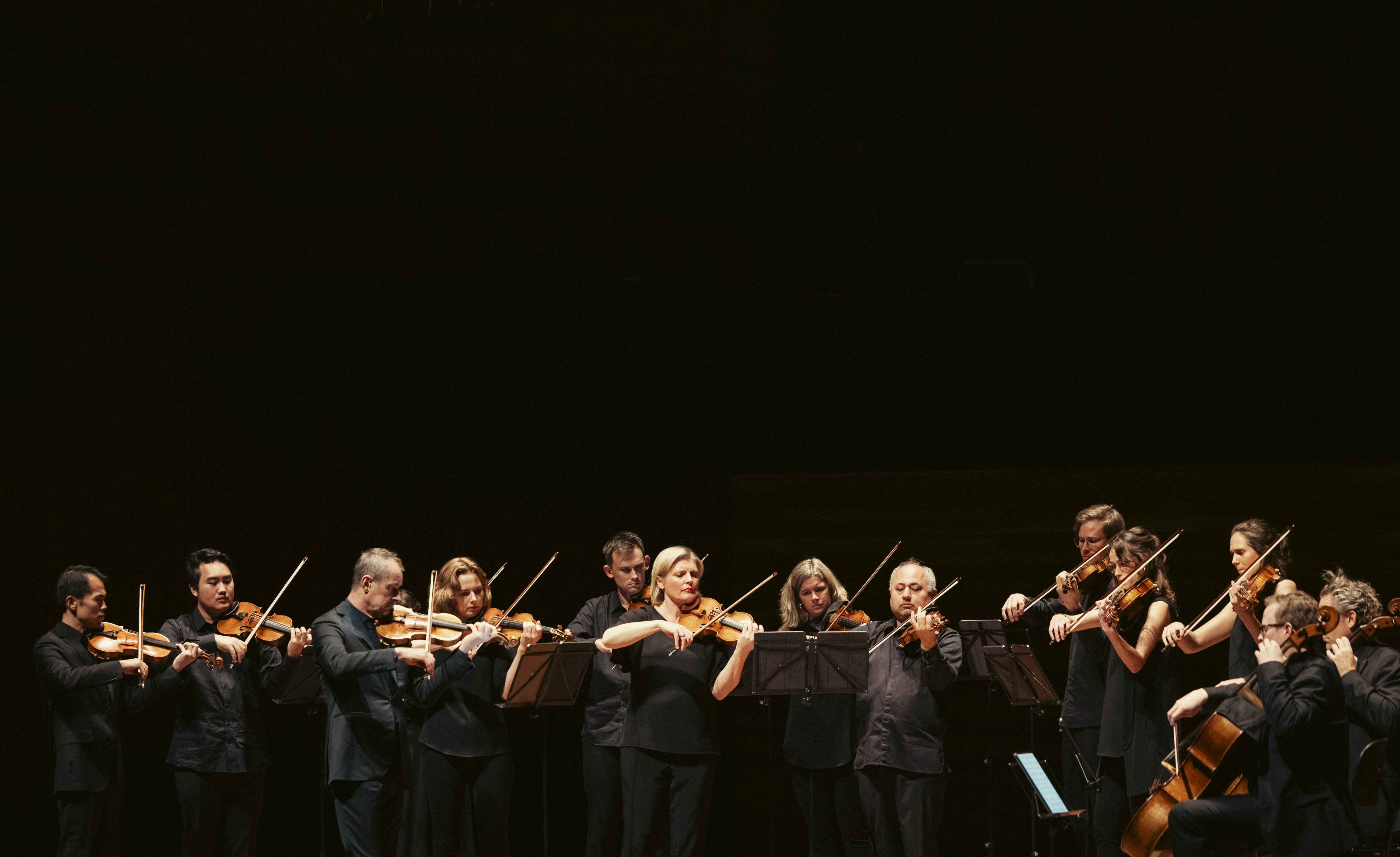
Cellist Julian Thompson – now celebrating his 20th year with the ACO – has two deep, abiding passions: music and surfing.
An essay from our Isles of Light program, written by Declan Fry.
Julian Thompson has just emerged from the surf when we speak in Sydney – he’s been out on the waves with his son. We speak via Zoom – a novelty for Thompson. Apart from the “blip” of Covid, Thompson’s world is one of physical engagement: with the cello, with audiences, with the presence of performance.
Thompson – who is celebrating his 20th year with the Australian Chamber Orchestra – describes his relationship with surfing as “one of those deep, abiding passions, possibly bordering on a vice”. The illicit aspect, it turns out, is that Thompson can’t stop collecting boards. “I’ve got them scattered all around my house. I got to the point where I was thinking, ‘Well, where can I hide that board I want around the house so my wife doesn’t find it straight away?’ That kind of thinking probably means that maybe I’ve got a board collection issue.”
Like performance, he says, surfing “taps you into the environment”. Thompson emphasises the importance of maintaining a connection to passions via habits and practices – what he calls, in the context of performance, “cello fitness”. The relationship between cello and performer is intensely physical and when he travels, Barry – a 1729 Guarneri instrument– sits beside him on the plane. (“He’s selfish and always takes the window seat.”)
I can’t help wanting to ask: why Barry? “Barry sort of epitomises a certain kind of cello sound that’s woody, textured, baritone. These low, sexy tones. We thought he kind of had some of the sexiness of Barry White.”
Thompson rarely says “I” when speaking about music. He comes from a musical family and the first-person plural pronoun informs his practice: his sister is a violinist and his two brothers are “both musically inclined”. Ballet and singing were musical mainstays in the household.
“My mum thought the cello would be a good option for me. I was a pretty big kid, had some big hands, and we already had a violinist in the family. If it wasn’t for them, I definitely wouldn’t have kept practising. I guess when you’re younger, if your friends are out playing footy or skateboarding, that’s a bit more instant gratification than working on your C-sharp major scales.”
His relationship with the ACO was one of love at first sight. He attended their recitals as a young teenager, captivated by seeing the British cellist Steven Isserlis.
“They were just a mind-blowing ensemble. Such sharp attack and unified sound and all moving as one. As a young Padawan cellist, to see this organism onstage, just doing amazing things that I hadn’t even imagined yet, was absolutely inspiring.”
Along with the rest of the ensemble’s cello section – Melissa Barnard (31 years) and Principal Cello Timo-Veikko Valve (20 years) – and Principal Double Bass Maxime Bibeau (28 years), there is almost a century of ACO performance between them. What has changed since he began, Thompson says, is his sense of himself as a musician.
“You know, playing the cello is not something that I do but something that I am. That’s how my mind and body have been shaped for so long."
"I perceive a lot of other things in the context of my understanding of the cello, the same way Bruce Lee talks about, as you master your kung fu, everything becomes kung fu.”
Thompson has recently returned from a regional tour with ACO Collective, the ACO’s education and regional touring ensemble that pairs the core musicians of the ACO with the country’s most talented emerging string musicians. As a mentor, he recalls his younger self, hyper-focused upon improving particular areas or technical aspects – a chord formation, playing at a particular speed. With its five-octave range, the cello can move from deep, double bass-like tones through a viola-esque mid-range and up into a soprano’s high singing registers. A cellist, Thompson says, is a “musical chameleon” for whom receiving knowledge through teachers is “critically important”.
“Looking back with a few more years, I can see that getting better comes incrementally. Vocally, if you go between two notes that are a long way apart,
you don’t just go from one to the next. You have to move between them. I feel like the cello has that real physicality when you sing on it well. It takes years before you start to be able to make sounds that you enjoy making, or even to really create musical shapes that you find satisfying. You’re gauging the desires and progress of the student and trying to work out, well, what can I put in the pathway that will generate change, or a strong reaction?”
Growing up in Canberra, Thompson found John Painter, founder of the ACO in 1975 and director of the Canberra School of Music, especially influential. His chamber orchestra program, Thompson recalls, “was inspiring and intimidating all at once.” Painter’s wife, Lois Simpson, a cellist who played with the ACO from its earliest days, taught Thompson at the Canberra School of Music. He describes her as a “very patient woman” who shaped his approach to sound and “the way you could make the cello sing.”
Now a Fulbright Scholar, Thompson has studied with Australian cellist David Pereira and completed a Master of Music in the United States with János Starker and Tsuyoshi Tsutsumi. He has played everywhere from Carnegie Hall to shearing sheds in the red dirt of Western Australia. In the interval between habits and practice, between audience and performer, starting out and two decades in, it’s not easy, as a cellist, getting from one note to the next. You must be flexible. Each time is a bit of a recital. You wait out a series of waves before the calm.
“Sound waves, light waves, ocean waves…,” Thompson muses. “At the end of the day, it’s all waves, isn’t it.”
You can see Julian perform in our upcoming national tour, Isles of Light.
Declan Fry has been shortlisted for the Judith Wright Poetry Prize and the Walkley-Pascall Prize in criticism. His fiction and poetry have appeared in Another Australia (Affirm), The Uncollected Animals (Turtle Point Press), and Woven (Magabala). A recipient of the Hilary McPhee Award, the Peter Blazey Fellowship, and the Griffith Review short story prize, Fry has written for The Guardian, The Saturday Paper, The Age/Sydney Morning Herald, Griffith Review, Memo and The Monthly and is a regular contributor to ABC Arts.