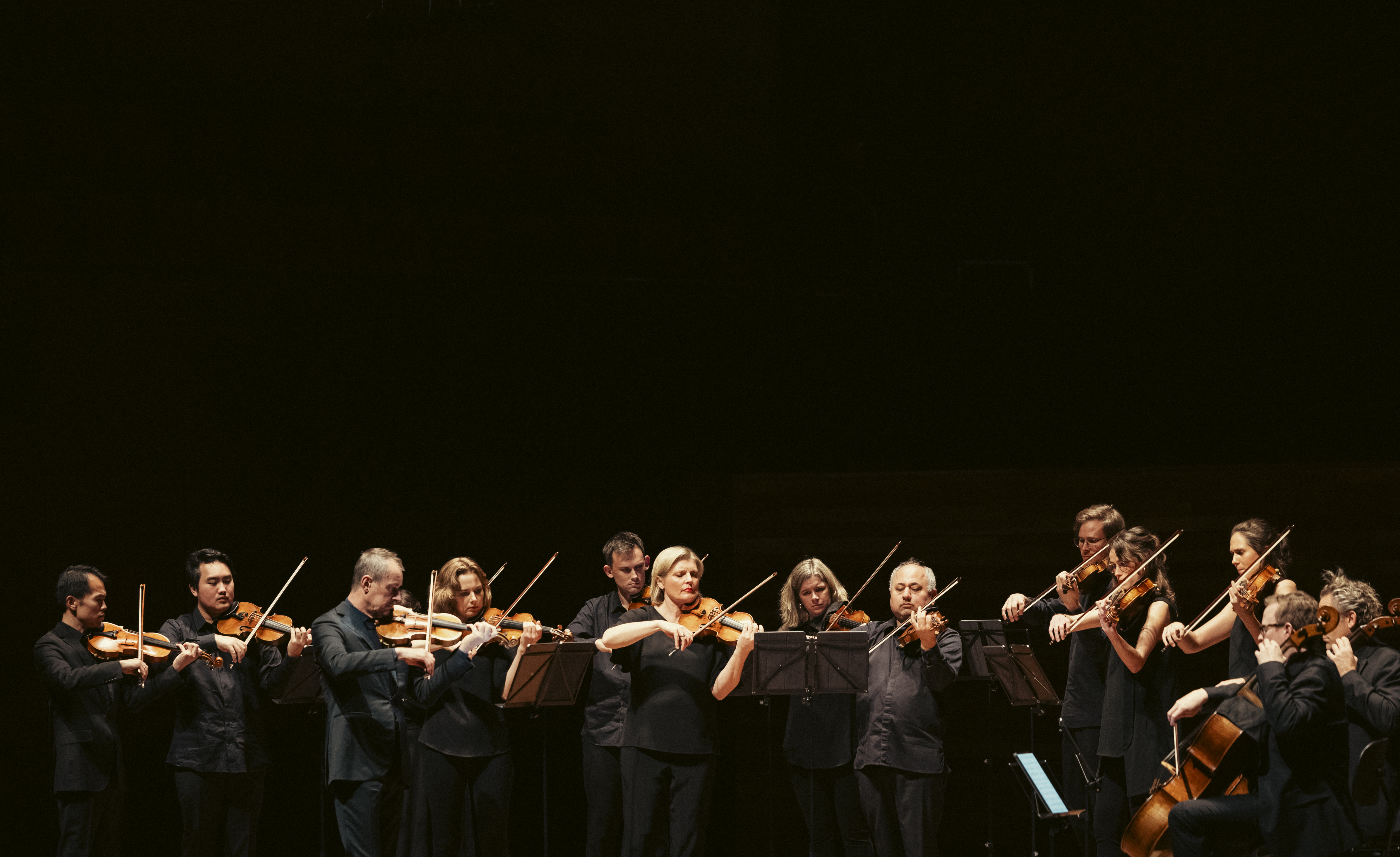
Johann Sebastian Bach’s Christmas Oratorio resonates differently in our secular age than it did for its original, deeply religious audience, but its impact is no less profound.
An excerpt from our program essay for Bach’s Christmas Oratorio, written by Kate Holden.
Bach's Christmas Oratorio is a 2026 special event, with just two concerts in Sydney and one in Melbourne.
A tremor in the air, a tiny shudder within the skull. Music barely exists: a matter of subtle emanation and infinitesimal bounce. Perhaps this is why, almost more than any other art, music – magical, fleet and miraculous as light – has always suggested a communication with the invisible divine; why it is the most elusive of arts, each note arriving and passing within the briefest moment, and yet one of the most enduring. From the antique Hurrian Hymns of Syria, 3500 years old, to the Gregorian plainsong traditions of medieval Europe, from the incalculably old incantations of First Nations Australia and the exotic sistrums and cymbals of cults in ancient Rome to the luminous piano music of Arvo Pärt and even the Christmas carols in shopping centres this week, music has been an enchanted conduit between humans and the heavens since we began.
As if in a fable, the oldest flute we know of was made, decades of millennia ago, from the wing bone of a swan. More than 40,000 years later, only a few hundred kilometres from the cave in southern Germany where that flute was played, Johann Sebastian Bach lived in Leipzig and wrote his Christmas Oratorio.
Composed in a small regional city by a man nearing 50, exasperated by his employers, testy with administrative conflicts and pragmatically using material he had already written for the celebration of royal infants and Saxon electresses, it is so gorgeous, so glowing with Christmas excitement that it rings to the rafters of concert halls – and occasionally still churches – to this day.
One of Bach’s three oratorios and also related intrinsically to the St Matthew, St John and (sadly lost) St Mark Passions, it is formed of six cantatas to be performed over six holy days: mostly material adapted from secular works, beautifully joined and rephrased to form one of Bach’s great choral works, a festive treat whose sumptuous richness is as delicious as brandy in a Christmas pudding.
Why do we cherish this, Richard Tognetti, a famous devotee of Bach, asks himself. “I know why I do,” he says. “It’s simply the music.” If he were a believer as well, Tognetti speculates, he might succumb to Stendhal syndrome, a debilitating stupor in the face of great art. “I’d become catatonic!” Bach’s original audience, he recalls, would have been “hardcore Lutherans in northern Germany”. It’s possible, he muses, that performing such sacred works for a general audience is a form of cultural appropriation. But if it is, they are works from a rich culture that always intended such music to be attractive.
For the Christmas season of 1734-35, Bach took cantatas, including several from a work for the Collegium concerning the Roman god Hercules, and transformed them. A piece celebrating a crown prince’s birthday became a hymn in thanks for God’s son; an aria of Herculean dilemma turned into a devout soliloquy; the aristocratic fanfare of trumpets and timpani that blared to flatter Maria Josepha of Saxony on her birthday now heralded the holy baby in the manger cradle.
Carefully chosen for their qualities according to the Doctrine of Affections, their potential to fit modularly into a new compositional schema and their tonal suitability, the cantatas were then given wholly new libretti, probably by Bach’s frequent collaborator Christian Friedrich Henrici, “Picander”, alongside a whole Gospel narrative of Christ’s birth taken directly from Luke and Matthew. Bach emphasised the chorales – like hymns, easy to sing along to – which were familiar to audiences and partly amended from Luther’s hymn book and continued his experiments with greater recitative. He swapped in parts of other works too, almost certainly including now-lost cantatas and perhaps even the unknown St Mark Passion, and wrote joining parts from scratch. Amid the glorious cantatas, the robust chorales and the exquisite sections for the Evangelist, he also incorporated passages in the galante style, a modern register associated with graceful, entertaining music rather than solemn worship, and even some folk-music idioms. This was a big work for a major community festival, intended to satisfy everyone.
Bach was explicitly warned by his town council against writing anything that seemed like opera, and famously never wrote one. But the Christmas Oratorio characterises the supple facility of oratorio – originated by St Philip Neri in his Rome oratory to appeal – to combine earnest piety with vivid narrative, action, character and spectacle. It’s opera’s “sacred sibling”, but biblical rather than pagan or classical. The drammi per musica (as opera was called) that Bach produced for the coffeehouse were simply re-librettoed and adjusted. This was apt rather than irreverent, especially as Bach, a monarchist, would have seen a direct progression from celebrating an earthly future king to rejoicing at the birth of the King of Kings. His “Oratorium Tempore Nativit: Xsti” fitted in with what J. G. Walther, in the most respected dictionary of music of the time, called oratorios: “sacred opera”, “rich in everything that art can muster in terms of ingenious and refined ideas”. Bach’s aim, without a doubt, was to worship his God through the most perfect music he could contrive. Most pieces he wrote, even the most secular, he signed “Soli Deo Gloria” (To God alone be the glory).
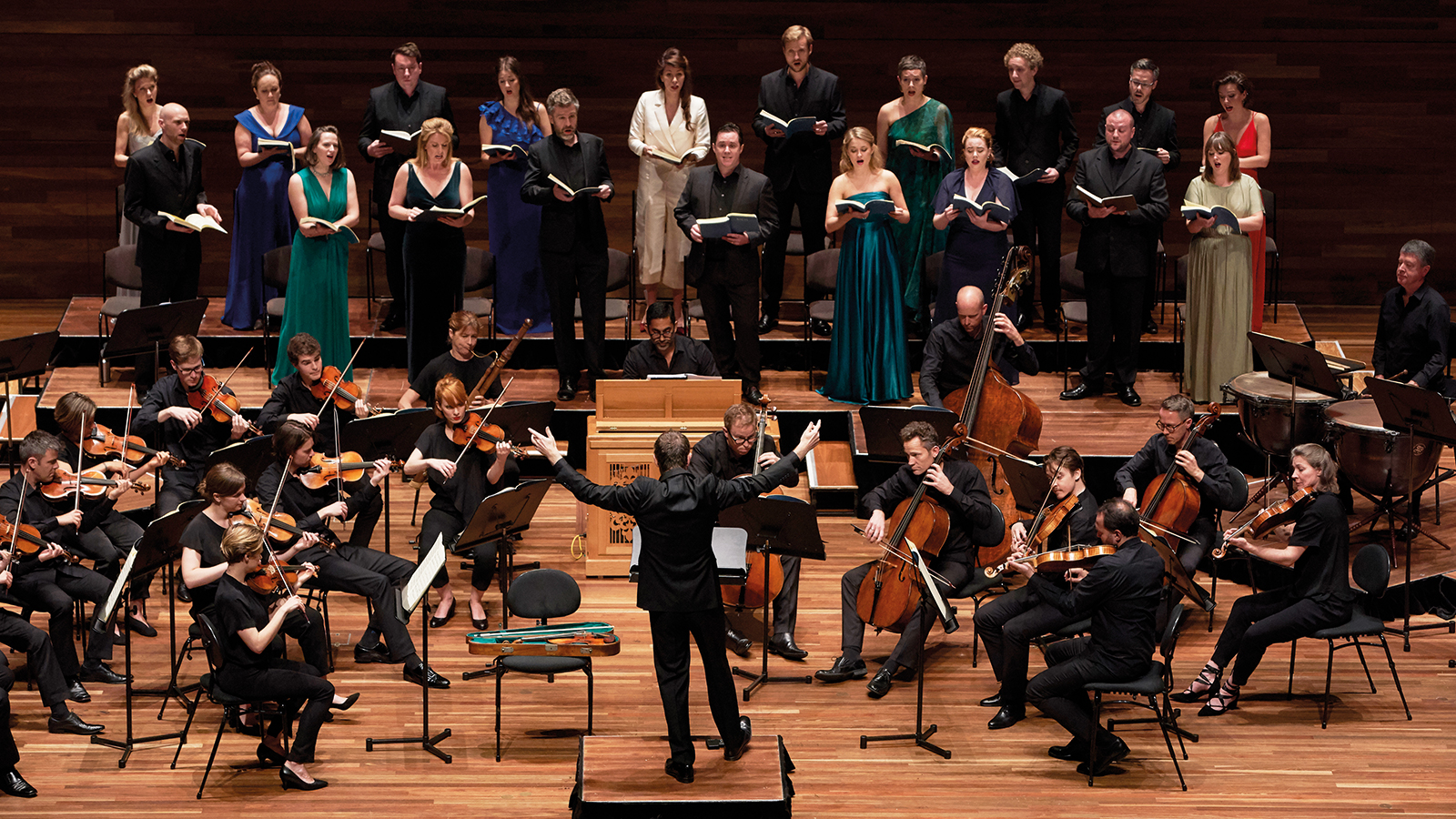
What of the modern experience? The Australian Chamber Orchestra has performed the Christmas Oratorio twice before, most recently in 2017. Pinchgut Opera, though veterans of other Bach oratorios, never has. “We’re really excited to do it, and this is a great collaboration between us,” Helyard says.
When playing, Helyard is always conscious of the man’s character: “He’s constantly a presence in his musical works and consequently is a presence for the musicians performing his works.” As a keyboardist, Helyard particularly relates to Bach, the eternal organist. “In these big works, he orchestrates things as an organist would. There’s a lovely architecture, a cohesive plan. He’s got a wonderful sense of colour in the Christmas Oratorio across all of the cantatas. And the sense of a community of the whole orchestra and the choir, singing at once? Superb.”
“I think every musician has a unique relationship with him,” Helyard says. He says it’s tough to play such a long program. “But Richard [Tognetti] is really extraordinary with Bach. I’ve worked with the ACO for over 25 years. I’ve played Bach with him and I’ve always loved Richard’s sense of finding that intimate moment in Bach. Richard and the ACO are very good at bringing the audience to them, like a flickering flame.
“It’s funny, because I’m always trying to find the theatrical in my operatic life. So I’m very excited to see how we work in this oratorio, because I’ll be preparing the chorus and, just like in Bach’s day, the chorus will sing all the solos, but also all the choruses as well. It’s a very big thing for them because usually it would not be done in one performance – we have a really long interval in this program. So in the hands of an orchestra like the Australian Chamber Orchestra, it is going to be really incredible.”
Playing on historic instruments from the era helps. “That’s the hardware, so to speak,” says Tognetti. “It’s fundamental to my reckoning with such music.” Historical re-creation is ultimately impossible, he says: the Oratorio would have to be performed with boy choristers, no women, different instruments and perhaps single voices. And ACO’s less-devout audience, which is not expecting divine rapture over the birth of Christ but the transcendent beauty of Bach’s music, is a different prospect. You could change the words, he jokes, and the music would retain its magic. He believes that no musician could ever object to playing Bach. “It’s the most extraordinary thing, that even the simplest part is a joy to play,” he says. “Every note feels right.”
Above all other things, according to James R. Gaines in his book Evening in the Palace of Reason: Bach Meets Frederick the Great in the Age of Enlightenment, J. S. Bach desired to demonstrate the depths of wisdom possible in the world, to manifest the perfect, celestial music of the holy universe, the immaculate harmony of divine order. The Christmas Oratorio was performed once in December-January of 1734–35, and not in full again until 1857. The ACO has performed it three times in 13 years. Its majesty shines through time like a Christmas lantern.
“We marvel when we hear music,” Luther wrote in 1538. When one voice is joined by others, a melody elaborated with instruments, the whole lovely creation reminds us “of a heavenly dance, where all meet in a spirit of friendliness, caress and embrace”.
-
Bach's Christmas Oratorio is a 2026 special event, with just two concerts in Sydney and one in Melbourne.
Kate Holden regularly contributes to The Saturday Paper and other publications. She is the author of In My Skin: A memoir (2005), and The Romantic: Italian nights and days (2010).
The Winter Road: A Killing in Croppa Creek (Black Inc, 2021) won the Walkley Book Award and the NSW Premier’s nonfiction award.