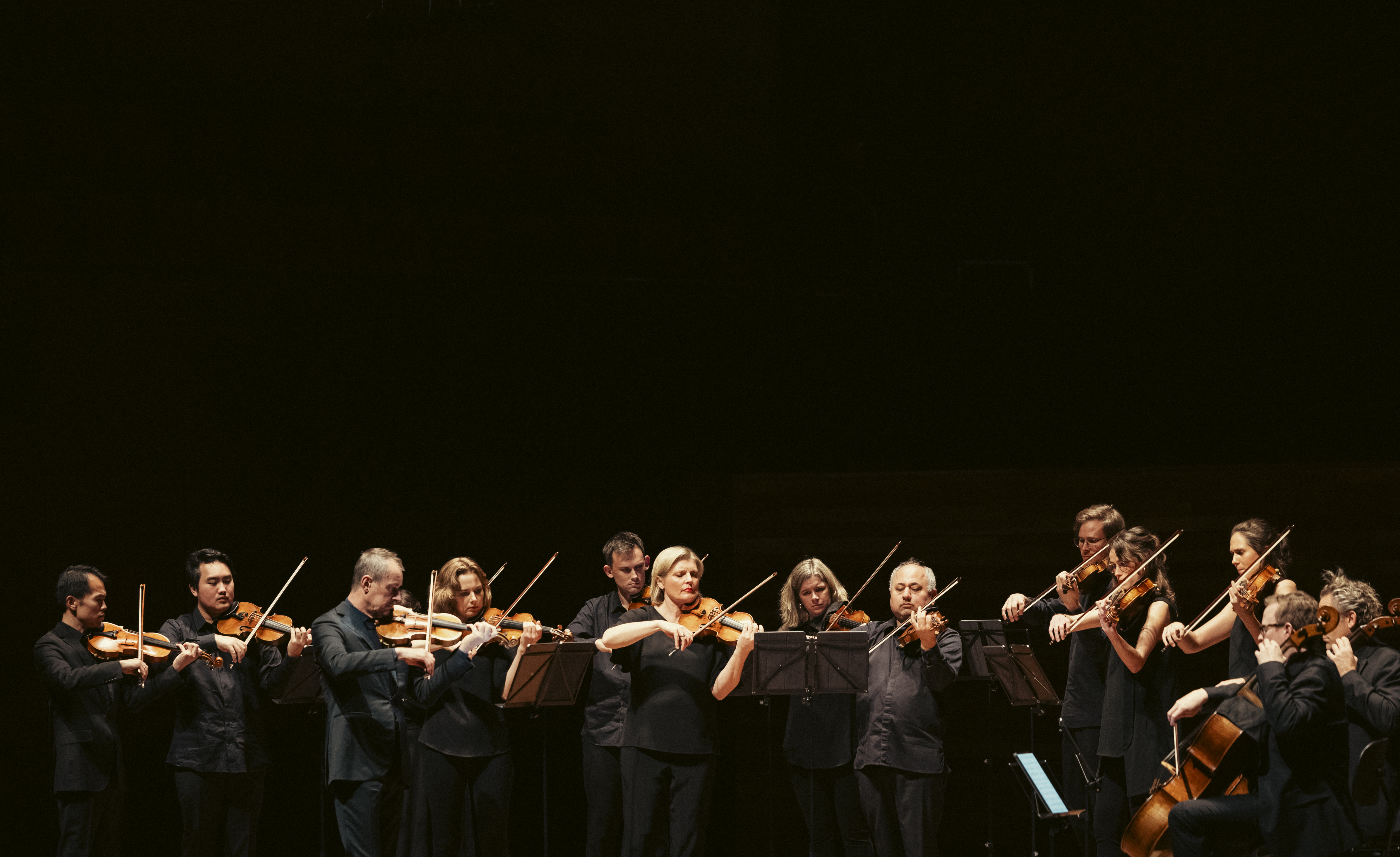
The drama of Beethoven’s later works invoked a universal language of emotion and human freedom that could travel anywhere – including to Australia. Below, an excerpt from our program essay for Beethoven's Pastoral, touring nationally in November 2026.
When the Australian Chamber Orchestra attacks the opening chords of a Beethoven overture, the sound has nothing of the dark wood and velvet associated with the late-19th-century concert hall. Standing to play, instruments strung with gut, timpanists wielding sticks bound with hard leather instead of felt, Richard Tognetti’s ensemble strips the composer back to an originary plainness and force. The audience is returned to Beethoven as he once was – a radical, volatile avant-gardist who wrote the soundtrack for our modern world.
By 1802, reeling from the knowledge that his hearing was now irreversibly failing, the composer fled from Vienna for the village of Heiligenstadt. In his famous testament written there, he confessed that only art kept him from ending his life. What emerged from that private torment was a valiant reimagining of music’s purpose. “In the autumn of 1802, Beethoven looked into the abyss of his silence and turned despair into defiance,” wrote composer and Beethoven biographer Jan Swafford. “His ‘new path’ was music about the process of becoming – the hero striving toward something, overcoming catastrophe to claim his own destiny.”
No longer would Beethoven compose within the accepted musical boundaries of his era. Instead, he would compose beyond them. Beethoven’s struggle is the lodestar of the ACO’s three-part program. In the Coriolan Overture, Op.62, for example, we meet a tragic hero – best known to Anglosphere audiences through Shakespeare’s Coriolanus, though Beethoven was drawing on Heinrich Joseph von Collin’s 1804 German play Coriolan. The drama of Beethoven’s dashing C minor opening gesture comes from how it embodies the profound adamancy of its subject: a man whose stubbornness is both his glory and his curse.
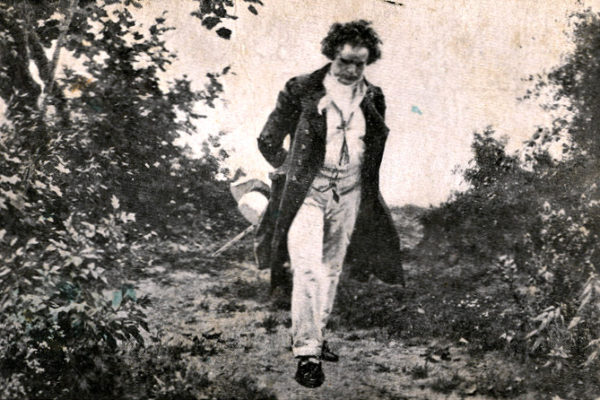
Image: Beethoven Walk in the Nature, by Julius Schmid
The tender and lyrical second theme of the overture, with its warmly maternal, supplicatory cadences, is met with a surprising musical response. Instead of being folded back into the musical structure of the piece’s conclusion – any dissonance overcome as the old classical rules require – we hear the aural equivalent of a man who can neither bow nor back away. As in Shakespeare’s play, it’s evident that the martial virtues inculcated in General Gnaeus Marcius Coriolanus make the Roman Capitol’s defender unable to lead the very civic sphere his actions have preserved.
Because reconciliation between the general and the citizens of Rome is impossible, the overture is unable to offer triumphant synthesis. The coda instead sees the initial theme break up into halting fragments, final shuddering breaths and a lapse into silence.
Where Coriolan ends in catastrophic isolation, the Triple Concerto, Op.56, models something more hopeful: a chamber music democracy. Rather than pitting a solitary virtuoso against a monolithic orchestra, Beethoven introduces a triumvirate of equals – violin, cello and piano. In the hands of ACO Artistic Director Richard Tognetti, Principal Cello Timo-Veikko Valve and Russian-Australian pianist Konstantin Shamray, the work becomes an intimate conversation negotiated within the larger orchestra’s sonic envelope. It is a composition in which democracy is held in delicate, uncoerced balance, not one more iteration of the strongman’s will to power.
Then comes the Sixth Symphony, the Pastoral. Composed alongside the relentless, fatidic drive of the Fifth, the Pastoral is, comparably, an astonishing act of Romantic decompression.
In the woods of Heiligenstadt, Beethoven walked with sketchbook in hand, scribbling down bird calls and rustic dance rhythms, insisting that his new symphony was “more an expression of feeling than painting”. For a composer who was losing his hearing, the surrounding countryside was an acoustic sanctuary. The Pastoral abandons heroic aggression in favour of the vast and meditative non-human realm.
It is a breathing meditation that expands outwards, in shimmering repetition. In the second movement, Szene am Bach, woodwinds suggest nightingale, quail and cuckoo without resorting to outright mimicry, just as the motion of water in the brook is not the sound of water in melody, but, as pianist and music critic Charles Rosen put it, “the movement of consciousness contemplating it”.
Likewise, in the fourth, Gewitter, Sturm, the force that interrupts this idyll is not a moral conflict but an elemental force.
As the composer Hector Berlioz put it, the symphony is no longer an orchestral simulation of a tempest: “It is the terrifying, blinding reality of nature itself.” It’s a storm that’s not resolved through some heroic human agency but which simply runs out of its own substance, leading to the final hymn of thanks in which humanity offers gratitude to nature, instead of a will to dominate.
Theodor Adorno, Beethoven’s great 20th-century champion, had a paradoxical response to the Sixth: for a work devoted to nature, he wrote, it “achieves an effect of true humanity”. It’s an idea worth holding onto as the ACO brings Beethoven into an Australian present. For what are Richard Tognetti and the ACO doing with their longstanding engagement with Beethoven’s work, both in terms of performance and recording, if not picking up this thread?
 Image: from the original autograph score of the Pastoral Symphony, featuring notations for birdcall, courtesy of Beethoven-Haus, Bonn.
The governing philosophy of Beethoven’s time belonged to G.W.F. Hegel. Famously, that great German thinker, who wrote voluminously on the music of his era, passed over Beethoven, the greatest orchestral composer of the time, in silence: a silence so total that it became eloquent. According to Hegel’s aesthetic program, Beethoven was a tough fit. The philosopher revered music to the degree that it expressed, with a purity unavailable to the plastic arts, the realisation of spirit, or Geist. Yet Hegel was suspicious of purely instrumental music, in which he saw the potential either for a retreat into merely mathematical experiment or a subjective, sonic free-for-all. It was better, he considered, that instruments be placed in the service of language, with poetry providing the scaffold of meaning around which music might cohere.
As Beethoven retreated into rural solitude and the groundbreaking drama of his late works, Hegel settled at the pinnacle of intellectual life on the Continent as Chair of Philosophy at the University of Berlin. Here his philosophy shifted from the open-ended odyssey of his early career to a more established, systematic doctrine. It was a system that had no place for the world beyond Western Europe – the theatre in which, he believed, History with a capital H took place.
The new colony in New South Wales had, it followed, no place in his thought. Though Australia was of the “New World” it was not, like North America, “the land of the future, where, in the ages that lie before us, the burden of the World’s History shall reveal itself”. Australia was too torrid, barren, strange and removed – with an Indigenous people who lived in unity with nature instead of in dialectical relation to it – to be an arena in which History could unfold.
Tognetti’s entire career has consisted of a brilliant, sustained act of iconoclasm against those who would lock Beethoven in a European cage.
Beethoven’s music proved Hegel wrong. Works such as the Pastoral freed music from language, while overtures such as Coriolan broke away from rigid classical convention. With them, the composer created a universal language of emotion and human freedom that could travel anywhere. His music pointed to a world outside Europe, to a history beyond “History”.
Such was its universality, that Australian composer Isaac Nathan – an impeccable Romantic who has been referred to as ‘The father of Australian music’, and who had collaborated with Lord Byron on Hebrew Melodies – cited Beethoven when arguing that Indigenous song in Australia possessed a pathos that European masters would have understood and respected. In his The Southern Euphrosyne, Nathan wrote of a “wild and plaintive beauty which would not dishonour the muse of Beethoven … [having] that deep melancholy which touches the heart without aid of artifice”.
For Tognetti and the ACO, the challenge has been to respond to these antipodean potentialities for Beethoven’s work, while removing the 19th-century barnacles that remain attached to it.
Tognetti’s entire career has consisted of a brilliant, sustained act of iconoclasm against those who would lock Beethoven in a European cage. Working from the premise that the ACO is first and foremost a hyper-responsive chamber ensemble, theirs is a Beethoven who emerges from the original dash and kineticism of the early Romantic era.
When [Tognetti's] orchestra lets rip with the Pastoral, it is a performance stripped to the waist.
The ACO restores to Beethoven his original vocabulary of unexpected dynamics – goosepimpling sforzandi, sudden, breathless subito pianos, elongated crescendos that collapse into the barely audible. As a conductor, Tognetti treats his scores like triathlon guide-markers; as a performer alongside his colleagues, their resulting musical dialogue is thrillingly swift and clean. And when his orchestra lets rip with the Pastoral, it is a performance stripped to the waist.
Tognetti’s Beethoven does not belong exclusively to Vienna, nor does he belong to Hegel’s circumscribed World. His Beethoven returns to Romantic origins beneath the skies of the Southern Cross. It’s a heroic act of translation and musical craft, of meaning freed from language and so explicable to all.
Geordie Williamson has been chief literary critic of The Australian since 2008. He is publisher of the Picador imprint at Pan Macmillan and most recently author of On Alexis Wright, part of Black Inc.’s Writers on Writers series.