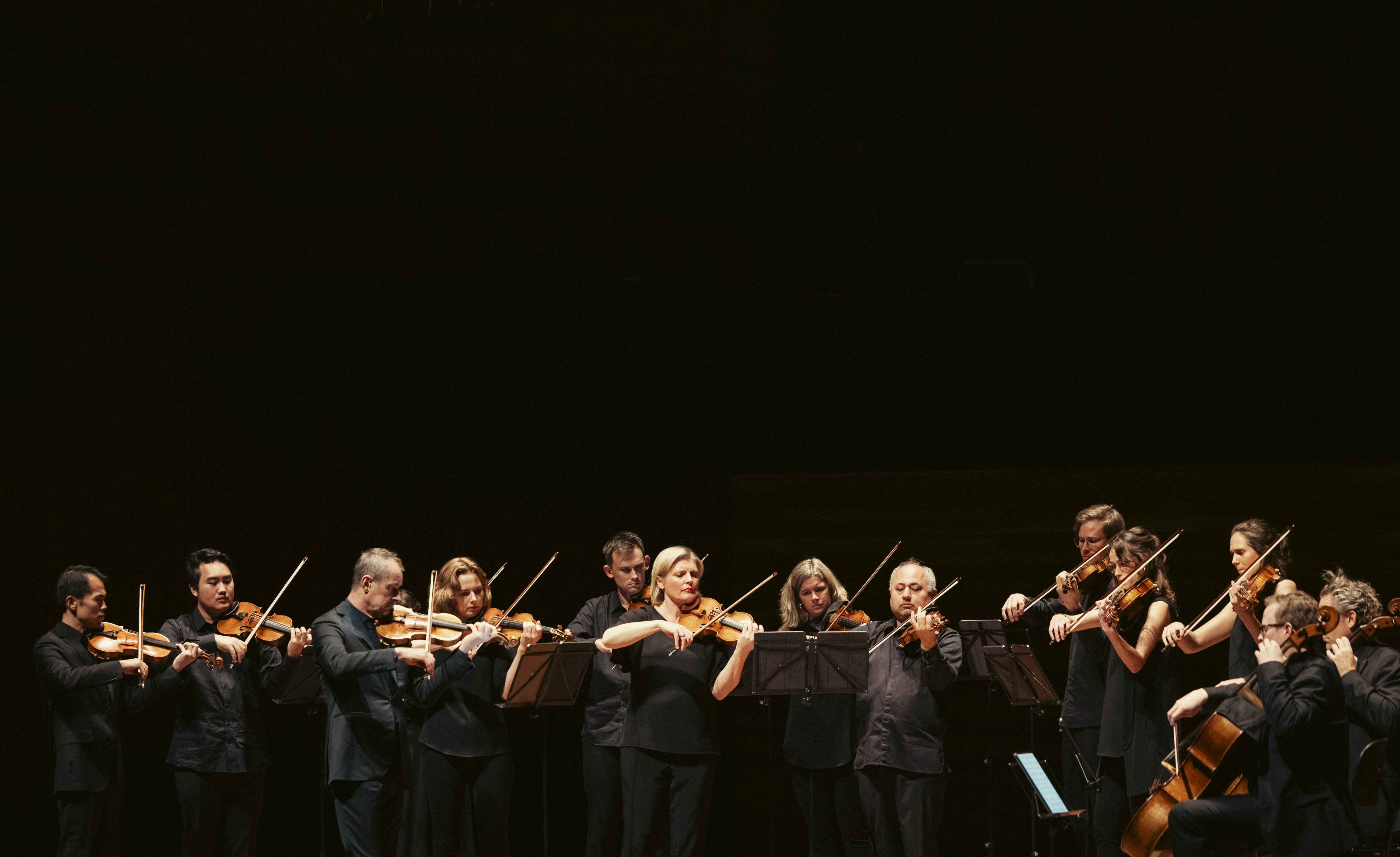
Finnish violin virtuoso Pekka Kuusisto’s daring programming for the Australian Chamber Orchestra reflects their long and profound collaboration.
An interview from our printed program for Pekka Kuusisto: Legends & Luminaries, written by Jana Perković.
Pekka Kuusisto’s relationship with the Australian Chamber Orchestra runs deep. “It’s a very long one,” he tells me from his summer home in Finland. “It was Finnish pianist Olli Mustonen, a very close friend of Richard Tognetti’s, and Steven Isserlis, the cellist, who introduced me to Richard, I think, 25 years ago. I did a few guest-directing tours with the ACO already in the very early 2000s. I’ve been in the ACO orbit for… forever.”
Kuusisto has been visiting Australia since the 1990s, and was artistic director of ACO Collective, the ACO’s educational and regional touring wing, from 2016 to 2019. He’s returning this year with another daring program for the ACO. “The tour was originally scheduled for 2021. It’s the longest Covid postponement I’ve had.” He jokes: “After it’s done, I think I won’t have any traces of Covid left in my diary.”
Kuusisto is a virtuoso violin player, boundary stretching composer and, increasingly, conductor. He is renowned for pushing the limits of what classical performance can be, and for adventurous programming, where he champions contemporary composers and freely crosses over into folk and electronic music. At 19, he was the first Finnish musician to win the International Jean Sibelius Violin Competition. He is currently Artistic Director of the Norwegian Chamber Orchestra and will be Chief Conductor of the Tokyo Metropolitan Symphony Orchestra from April 2028. But Pekka Kuusisto is a bona fide celebrity in my house owing to yet another towering achievement: he composed and performed the soundtrack for season one of the recent Moomin animated TV series.
Little whimsical Moomintroll, created by Swedish-Finnish artist Tove Jansson in the final days of World War II as a passionate rebellion against the rigidity of Nazism, is something of a Finnish national treasure. But, Kuusisto tells me, there is a particularly deep family connection at play. “My father wrote an opera about Moomin in 1974 together with Tove Jansson. We had little drawings [at home] made for him by Tove.”
The opera premiered less than two years before Kuusisto was born and may be why he and his friend, percussionist and sound engineer Samuli Kosminen, were asked to make an audition tape.
“They asked us to make a song about, you know, just an ordinary day in Moominvalley,” Kuusisto reminisces. “I was playing a very expensive 1728 Stradivarius at the time, and we made sure to have the violin at the very beginning of the track.” He laughs. “So it got us the job.”
For a year and a half afterwards, “we were constantly just writing and recording, writing and recording”. To accommodate Kuusisto’s extensive international touring, Kosminen often travelled to wherever Kuusisto was playing, recording in hotel rooms and backstage at concert venues. The unusual soundtrack, imagined “like it could have been played in Moominhouse on handmade instruments, maybe weird instruments that Moominpapa could have brought from his adventures around the world”, sounds nothing like a cheap kids’ record. It is a series of whimsical, warm, folksy instrumentals.
It is also representative of Kuusisto’s exquisitely joyful, eclectic and unpretentious musical output. Kuusisto is known for engaging in radical, unusual projects. In 2014, he joined the Mahler Chamber Orchestra for a performance night that matched Bach, American minimalism, and electronica, with performances by contemporary dance ensemble Sasha Waltz & Guests, juggler Jay Gilligan, DJ Georg Conrad and video artist Lillevan.
With the Norwegian Chamber Orchestra he was the music director of DSCH, a high-concept visual concert based on Shostakovich’s music and life, performed by 18 soloists in costume. A 2018 recital in Wigmore Hall overlaid Bach and Steve Reich with photographs of cancer cells and readings by cancer researcher Suvi Savola. With Greenpeace, Kuusisto developed a version of Saint-Saëns’ Carnival of the Animals children’s concert that centres animal rights.
“Any time somebody does something to expand the concert culture, the regularities and mechanisms of a normal concert, [every time] we go outside of that narrow field – I think it’s always worthwhile,” Kuusisto has said.
He also loves folk music, and will passionately discuss Sibelius’s debt to runic song. He conquered hearts and minds in London in 2016, when he wrapped up his Proms debut at the Royal Albert Hall with a singalong to a Finnish folk song. He likes to call his instrument the “fiddle”. In February 2026, he released Willows with the Norwegian Chamber Orchestra, a delicate record marking the passing of his parents and his brother, that brought together a luminous rendition of Vaughan Williams’s The Lark Ascending and new compositions by Caroline Shaw and Ellen Reid with traditional American songs in new arrangements by folk singer-songwriter Sam Amidon (who happens to be musician Beth Orton’s husband). This, Kuusisto says, is the kind of stuff he wants to do more of.
Kuusisto was always surrounded by music. His grandfather, Taneli Kuusisto, and his father, Ilkka Kuusisto, were composers and organists. His mother was a music teacher, and Kuusisto and his brother, the late Jaakko Kuusisto, started learning violin at kindergarten age. By the time they were seven and nine respectively, they were performing as soloists on Finnish national television, looking small, serious, and with matching bowl cuts. They also have two half-sisters, dancer-choreographer and actor Lotta and dance teacher Sanna Kuusisto. “My family is completely musical,” Kuusisto said in an interview for the Philharmonia Orchestra. “It was hard to avoid becoming a musician; I’m happy I didn’t succeed.”
Kuusisto describes to me his musical upbringing as both ordinary and atypical: a “wonderful Hungarian early teacher” followed by a specialist in the French bow technique, all overseen by his mother. When Pekka and Jaakko Kuusisto were teenagers, the whole family moved to the United States so the boys could study at Indiana University with Miriam Fried and Paul Biss “to get that final, proper violin soloistic training”.
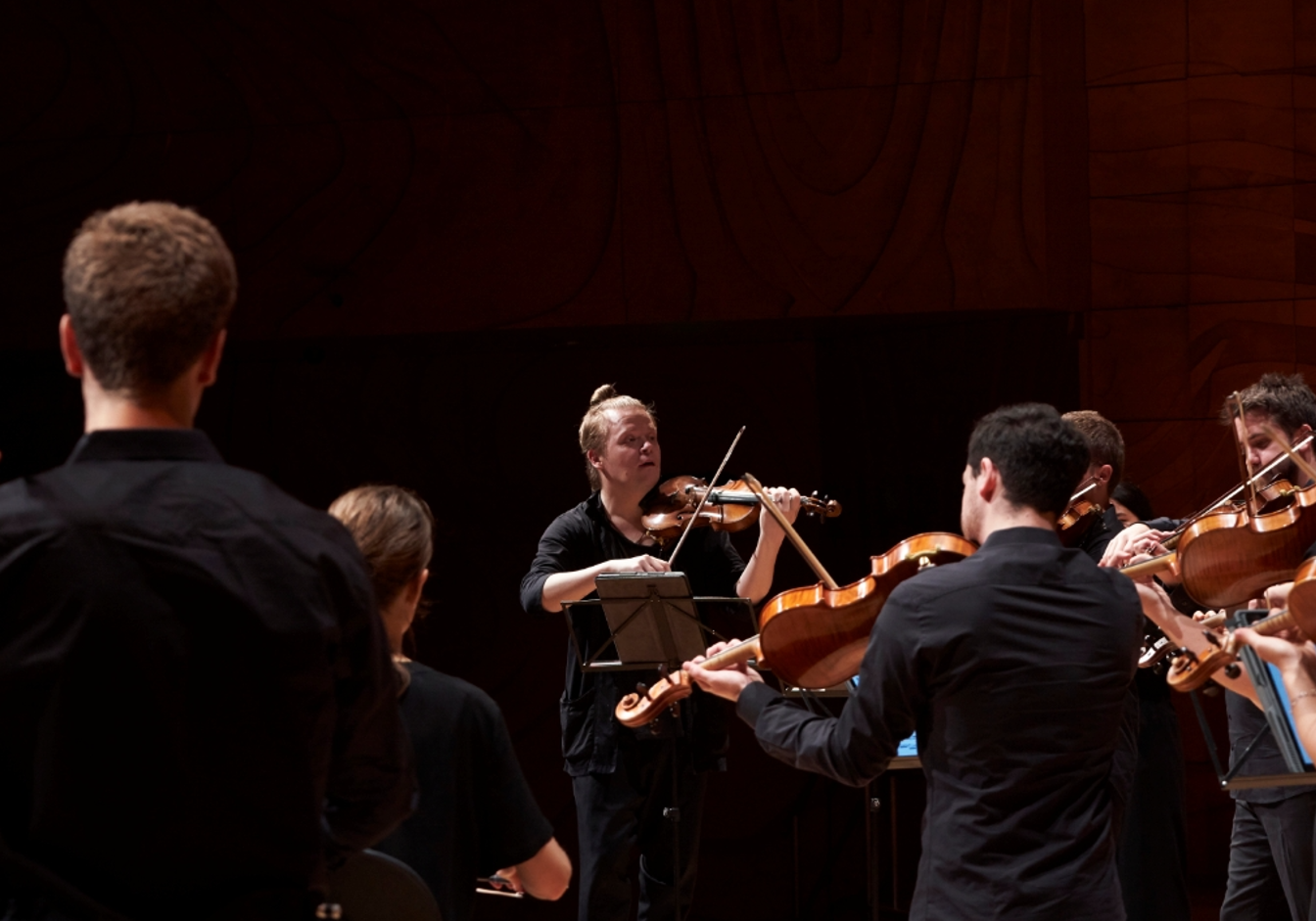
Pekka Kuusisto and ACO Collective, 2019. Image by Zan Wimberley.
“All that was perfectly normal. But jazz and, later on, electronic music, improvised music and, finally, traditional, folk music – I think that was something that we had, that a lot of our fellow students and colleagues didn’t.” Kuusisto pins this on his father’s influence. Ilkka Kuusisto was sent to New York as a young man, to study religious music, and discovered jazz instead. “He wanted to be a sailor and have music as a hobby. But then he met jazz, and decided: ‘If music can do this, I want to be a musician.’ So sailing became a hobby and music became the job.”
Kuusisto vividly describes sitting by the piano with his brother and father: “He would play Satin Doll by Duke Ellington, for example, and one of us would go to the bass end of the keyboard, play bass lines, and the other would go to the top of the keyboard and play an improvised melodic solo. Then we would change places, so that each one of us would get an understanding of what notes fit and what notes don’t; what rhythms fit and what rhythms don’t. The idea that you can invent your own music, even though you’re a violinist, was part of the deal from the very beginning.”
Fortunately for us, Kuusisto enjoys long-haul travel. “It feels, still, like borrowed time,” he says. “Nowadays there is internet on most planes – but people still don’t expect you to be fully available when you’re travelling from Finland to Australia.” And, he adds, “for some reason, I’ve always enjoyed existing in Australia. The general attitude, or what I perceive as the general attitude of people, is really hospitable. And the level of music-making is amazing.
“Through the ACO Collective, I felt like I had a real grasp on what kind of young string players are growing up in Australia.” He mentions a dozen names who are now notable musicians in orchestras around the world. “The amount of really innovative, interesting young string players coming out of Australia is quite staggering. It feels really groundbreaking. People don’t only get educated [in] how to play music and an instrument, but they get educated [in] how to invent a life in music. How to be curious about what it is that they really want to do in music. And that, that’s brilliant. “For a long time,” he continues, “a lot of the top-level education in something like violin-playing has been focused on becoming a soloistic player. Maybe a quartet player. Or taking auditions, and then playing in an orchestra for 40 years. But I don’t think musicians in general are quite cut out to be placed on career paths.
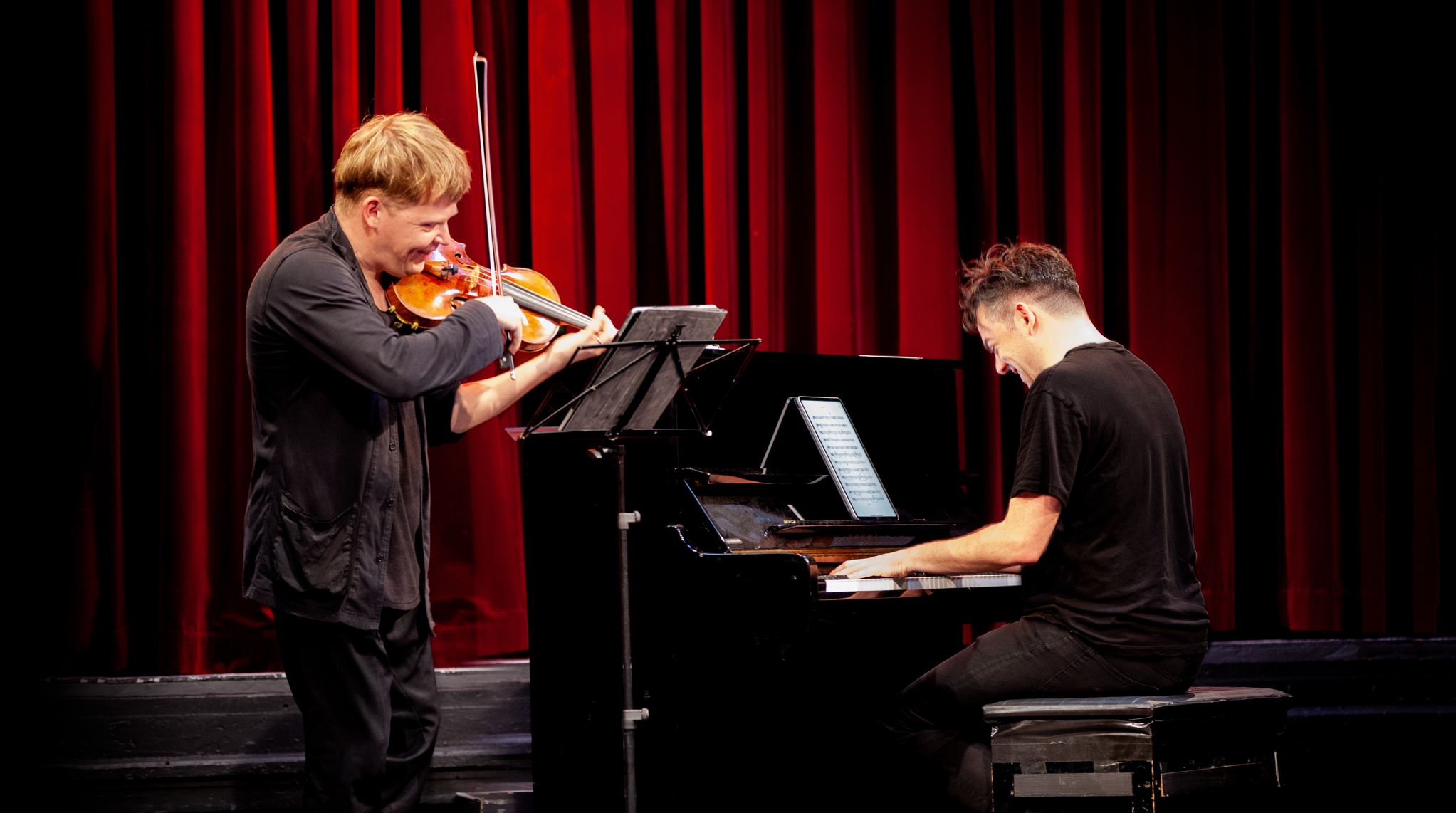
Pekka Kuusisto and Nico Muhly in Sydney, 2019. Image by Cameron Emerson Elliott
“Because this [training] takes so much time and so much focus, there’s a danger that your way of looking at your professional life gets narrower and narrower. Then you make the mistake of accidentally believing that you were put on this earth to play in a violin section in an orchestra. And maybe you weren’t. I think it was Miles Davis who said that sometimes it takes a long time to sound like yourself,” he muses. “I think there is something about the instrumental education that can close your windows a bit. And that’s something I’ve felt with a lot of the kids that I got to work with in Australia – that their windows were open.”
In contrast, he says: “To invent a life of your own kind, in music, means discovering what you’re good at, and discovering what you’re interested in becoming better at. And then just try to build a community of musicians and see what you can do.” He names the example-setting ACO tours with ACO Collective, the education at the Australian National Academy of Music and Sydney Conservatorium of Music, and Musica Viva Australia’s music-making between birds and violin?’ And the organisation says, ‘Go for it, here’s a little bit of money, make a concert.’ And then something grows from that. That’s just insanely exciting.”
The centrepiece of Kuusisto’s program for the ACO is Shrink, a concerto for violin and strings by Nico Muhly, commissioned by the ACO and composed specifically for Kuusisto. It premiered at the Melbourne Recital Centre in late 2019. “We thought, ‘This is a fantastic piece of music, and we worked hard on it – we should tour it properly.’”
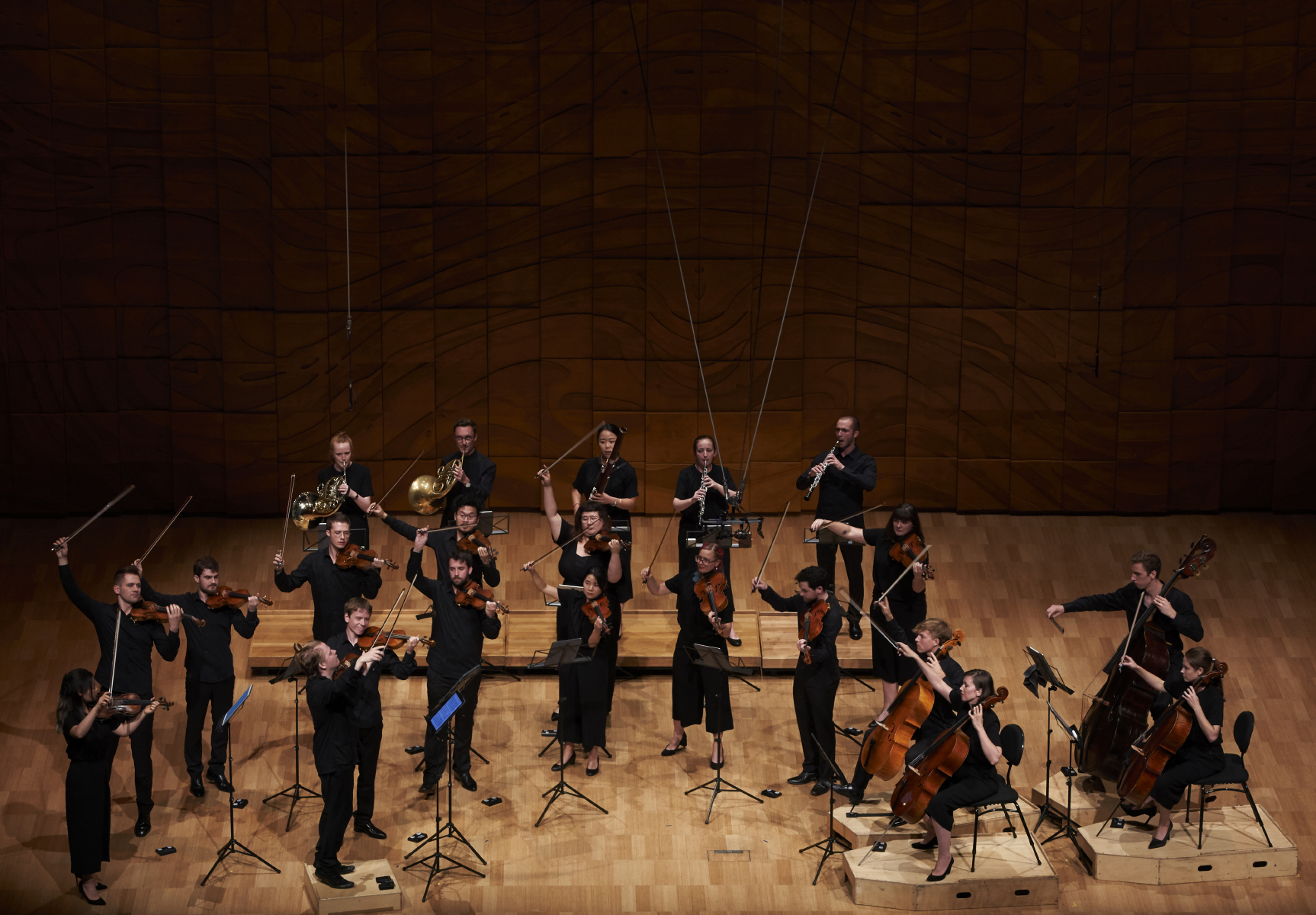
Pekka Kuusisto and ACO Collective, 2019. Image by Zan Wimberley
Also on the program is West Coast Sky Eternal, a new piece for string orchestra composed by Ellen Reid, a composer Kuusisto loves and champions.
“Ellen Reid’s chamber opera, called p r i s m, is actually the reason I decided to study conducting,” he says. “I thought, ‘If being a conductor gives me the influence to program music like this one day, then it’s worth studying.’ I would go as far as to say that she is one of the most important voices in composition at the moment – so definitely a big feather in our cap to get to play her music around Australia.
“Ellen herself explains the piece as zooming in and out of landscape. As it happens with a lot of great music, I think everyone will hear bits and pieces of their own life in it. I will say only this: it’s extremely tricky, unbelievably fun to play.”
Muhly and Reid’s contemporary pieces are paired with works by two recognisable names. “Mozart and Mendelssohn are fitting with the theme of Nico [Muhly]. Because, if there’s a composer alive today who has the same sort of lightning-speed brain that I imagine Mozart and Mendelssohn would have had, or must have had, then Nico would be one of my top candidates.” Mozart is represented with The Magic Flute. Years ago, German festival director and cellist Jan Vogler introduced Kuusisto to a pile of anonymous arrangements of The Magic Flute for string quartets.
Kuusisto decided to re-arrange them for a full string orchestra, and the concert will open with a selection from that “pile”. “We can’t play all the hits, because there’s not a single movement in The Magic Flute that isn’t a hit – we’d have two hours of an opener!”
The final piece is Felix Mendelssohn’s String Quintet No.2, arranged for string orchestra. “Arranging a string quartet for string orchestra is quite normal, but arranging string quintets – unfortunately – happens less often, because the balancing within the orchestra goes easily wrong. But now we have several players in the ACO who can swap between violin and viola – and that opened the possibility of having the Mendelssohn quintet.” And, he adds enthusiastically: “It’s incredibly good! It’s one of my absolute favourite pieces of music. If Schumann had a really happy day, this is the kind of music he would have written. Plus, it sits on the instrument a lot better than any Schumann. It’s glorious fun.”
A few years ago, I heard Kuusisto describe the joy of something akin to improvisation within classical concerts: “It’s possible, sometimes, to make decisions that wouldn’t come to you in a rehearsal … Something happens; the spirit moves you and suddenly something feels like a grand idea.” He described the special moment in which tiny bodily signals – a gesture, a movement – alerted other players to jump on board. “And the more you know the people you play with, the further you can take the situation. If you listen to great jazz groups or great traditional music groups that have played together for decades, you hear it instantly.”
So it’s no wonder that this is one of the aspects of playing with the ACO he cherishes the most. “Programming for the ACO, you know that everything is going to be played 10 or 12 times. One of the luxuries is that you can improvise a lot with the interpretation. On tour, once you’ve gotten the first couple of shows down, things start to happen between the musicians that are unrehearsable, that can only happen in concert, when everyone really knows the music very well. You start to take risks with each other.” His eyes light up. “The ACO is such a brilliant, risk-taking orchestra. I think the program will become a completely different animal during the tour!”
Pekka Kuusisto: Legends & Luminaries is touring nationally, 3-19 October 2026.
Jana Perković is a cultural critic and editor, living between Melbourne, Berlin and Copenhagen, who works in academia, the arts and private practice. She co-created a popular best-seller, The Ideal City, for IKEA’s innovation lab SPACE10, and edited Assemble papers between 2017–2020. Her critique and essays have been published widely in Australia and Europe.