An essay from the program for Mozart's Last Symphonies, written by Madeleine Gray. Drawings by Bertie Blackman.
“There are enough dry German musicologists who try and turn Mozart into some sacred being,” he says. “He wasn’t. He was a dirty little foul-mouthed scatological eccentric with the most amazing gift, and his music resonates today, whether you’re in a lift or a dry concert hall, concentrating hard.”
As a writer of fiction, I am accustomed to sniffing out stories wherever I go, making meaning from signs and symbols, inferring clues from context. I want to wrap the world up in narrative and then unwrap it. Were I writing about any work of music by Mozart other than his final three symphonies, this would be relatively easy.
"He was a dirty little foul-mouthed scatological eccentric with the most amazing gift"Richard Tognetti on Mozart
As Tognetti explains, unlike Shakespeare or Bach, we know a lot about Mozart. We know about his economic stresses, his relationship with his tiger father, where he lived, his Freemasonry, his troubled relationship with the aristocracy. If I were writing about The Magic Flute, for example, I could make a clear case for it being a Masonic fable about self-improvement. Were I discussing Don Giovanni, I could philosophise at length about unbridled ego, the necessity of repentance, the (false) value of class boundaries. But “there’s a strange hole in the information trail about these last symphonies and why he wrote them”, says Tognetti. “For whom? And did he get paid? They may or may not have been performed.” The context around these symphonies is lost. And what we are left with is pure abstraction.
For Mozart lovers, his final three symphonies – No.39, No.40 and No.41 – have achieved folkloric status. “It seems that he wrote this music for him and God alone,” Tognetti says. “And that’s what makes this music so wonderful, in this day and age. It’s quite refreshing. You can’t ascribe some kind of theory to the music. That’s what makes it so extraordinarily compelling for me.”
Perhaps we can at least attempt to describe the symphonies? What do they sound like? No.41, nicknamed Jupiter by violinist Johann Salomon in reference to the majesty of the ancient Roman sky god, is “a revelation”, says Tognetti. “He fuses multifarious melodies together, fugues and counterpoints, seemingly in patchwork form, culminating in this extraordinary climax. When you consider the technical prowess, the emotional complexity, the beauty of it, it’s absolutely mind-blowing.” I would add that it is epic. It traverses moods with the swiftness of a tired toddler, it builds like a thunderstorm, it is bold and loud, gentle and quiet, graceful, then somehow… it is everything all at once.
“The 40th symphony is a dark, unfolding drama, totally different,” says Tognetti. “It is confoundingly modern and complex, but at the same time there is always a shimmer on the surface. And there’s a virtuosity in the 39th that is a totally different cup of tea as well.” He continues that the three symphonies are, “surely, one of the greatest feats of humankind.”
I ask Tognetti if he might compare any of the three symphonies to literary characters or to other works of art. At first, he demurs. He explains that, due to the abstraction, such a task would be impossible. Then, to my pleasure, he begins to bend.
“Well, you wouldn’t say it’s Solzhenitsynian. You wouldn’t say it’s Kafkaesque. You wouldn’t even say it’s Proustian… There is something of Jane Austen, in the precision of the language and the way that the mundane can be described and deconstructed, capturing the imagination.”
Excellent, Jane Austen it is. To my mind, there does seem to be something of Mr Bennet in Mozart’s character: the two share a common ineptitude with money, a comic view of the world and a subversive wit. It is less likely Mr Bennet would do as Mozart did, titling one of his songs Leck mich im Arsch (“Lick me in the arse”), but of this we cannot be certain.
We can be certain Mozart died when he was only 35. When he wrote these three symphonies in the summer of 1788, he had no way of knowing he would perish three years later and that these would be his final masterpieces.
“What’s amazing is it feels like you can’t imagine him writing anything else after this,” Tognetti says. “What if he had lived to his 70s? Then what? Pre-Brucknerian symphonies? Continuing to write symphonies No.42 and No.43 all the way up to No.105 to beat Haydn?"
He wasn’t to know that these would be his last, but it feels like these three symphonies are the culmination of his extraordinary career.”Richard Tognetti on Mozart
To my satisfaction, Tognetti is drawn back into my web of association. “Actually,” he says, somewhat out of the blue, “these symphonies are more like Nabokov. Like Nabokov, Mozart didn’t constrain himself to the obvious notions of the time. There’s precision. There’s something that transcends politics and societal mores.”
Given this, I wonder whether it’s possible Mozart was influenced by his German contemporary Immanuel Kant’s non-imagistic writing style in The Critique of Pure Reason – its revised second edition was published a year before Mozart wrote his final symphonies. In The Critique, Kant refuses to use metaphor or simile to explain his ideas, as he believes both techniques only point to something being like something else rather than expressing true essence.
Tognetti doesn’t bite. “Yes, but the thing with Mozart is that even though he lived during the Enlightenment, he was arguably not a character of the Enlightenment,” he says. “He doesn’t seem to have been a deeply philosophical person, outside of his freemasonry. This was someone who lived life, instead of talking about it. When Voltaire died, Mozart celebrated.” Tognetti recites to me a quote attributed to Mozart: “That godless fellow and arch-rascal, Voltaire, is dead — died like a dog, like a beast. That is his reward.”
“He wasn’t in touch with Goethe,” Tognetti continues. “He was just trying to get a gig. While he’s worshipped as a saint in Austria now, where they’ve made a fortune selling chocolates with his face on them, he was treated very badly during his life and completely underemployed. Life was tough, and still the music was just flowing out of him.”
It’s clear that Tognetti feels a real affinity with Mozart, a kindred energy I would characterise as a “clever ratbaggedness”.
Tognetti first became Artistic Director and Lead Violin at the ACO 36 years ago. In his first year of directing, the Orchestra performed Mozart’s final three symphonies, with Dutch conductor Frans Brüggen. “I loved his poetry so I loved doing it, but we perform the symphonies very differently now.”
How does playing the same music again and again over so many years feel? How does the experience or effect differ? “It's like doing Shakespeare,” he explains. “You don’t just do it once and that’s that. You've got to keep on reassessing, opening them up. Your interpretation is not immutable. And the audience’s reaction and tastes change with the years as well… That being said, in my time, these three symphonies have been perennial.”
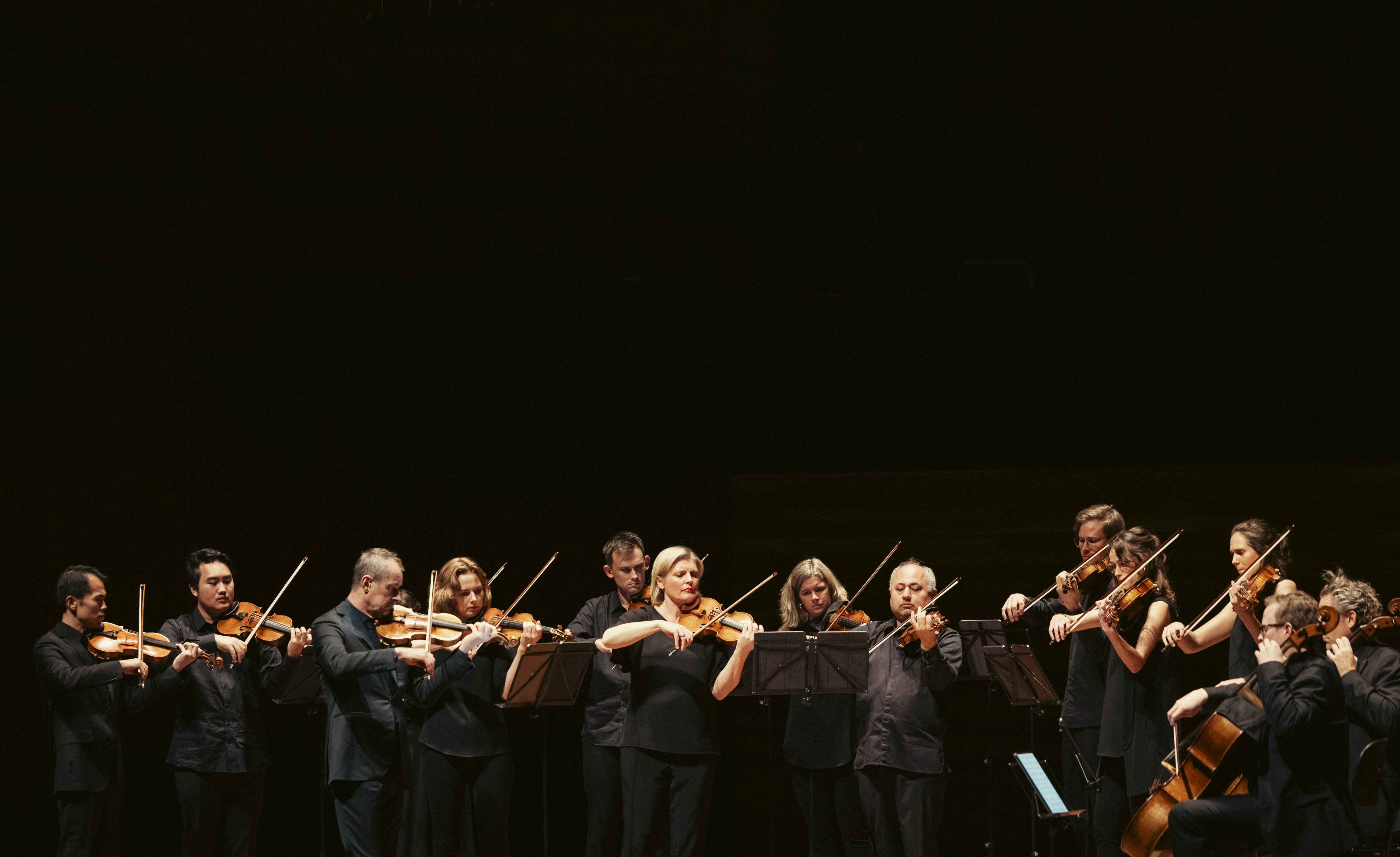
When Tognetti conducts, he ‘play-directs’, standing within the orchestra, playing violin and leading simultaneously. This is not revolutionary, he explains. It is reflective of how conducting worked in Mozart’s time. Indeed, Tognetti is suspicious of those who would claim Mozart himself was “avant-garde”. “I think ‘avant-garde’ is a modern way of defining art in order to give it a bit of spice,” he says. “I would say he was ‘advanced guard’. ""Mozart wasn’t running around the place blowing up traditions. He changed traditions, but he didn’t blow them up.”Richard Tognetti
Tognetti is known for his individualism, his boldness – The Guardian has described him as an “anarchist” – but he is also protective of tradition, respectful of the past. It’s about a balance of the two.
“A lot of orchestras have this notion that the piece is sacred. But I don't know of any composer that considers their own music sacred. Whenever you work with the composer, they want to see how you breathe life into their work.” Even so, the ACO uses instruments, or copies of instruments, from Mozart’s time, or in some cases, made even earlier. “When you hold that old bassoon, it feels quite different,” he says. But there is a haptic continuity there, certainly – a trans-temporal bond between musicians playing the same instruments.
I love the idea, propagated by cultural theorist Byung-Chul Han but inspired by Deleuze, that to resist the data-driven self-surveillance of neoliberal society, we must instead choose to play “the fool”. The fool is one who becomes incommunicable, who sees the world askance, who listens and doesn’t always respond. Of Mozart, Tognetti says,
“He played the fool, the buffoon, the nincompoop, the vulgarian, but in a good way. If you’d met him, you would have been equal parts disgusted and compelled. You definitely would have wanted to go to the pub with him.”
We all contain multitudes, from the ridiculous to the sublime, and in Mozart’s final symphonies we are invited to feel them all.
-
Mozart's Last Symphonies is a special event, touring to Sydney, Brisbane, Melbourne and Canberra, in September 2026.
Madeleine Gray is a critic and novelist from Sydney. She has a Masters in English from the University of Oxford and a PhD in feminist literary theory from the University of Manchester. Her first novel, Green Dot, won the 2024 Matt Richell Award for New Writer of the Year, the 2025 Russell Prize for Humour Writing, and was shortlisted for Debut of the Year at the 2025 British Book Awards. Her second novel, Chosen Family, was shortlisted for Literary Fiction Book of the Year at the 2026 ABIAs. She has been a finalist for the Walkley Pascall Prize for Arts Criticism and is now a regular book reviewer at The Saturday Paper and on ABC Radio National’s The Bookshelf. She also happens to be Bertie Blackman’s wife.
Bertie Blackman is a multidisciplinary storyteller from Sydney. Her work as a writer, musician and artist is highly imaginative, weaving between the real and unreal, illuminating her unique universe and inviting us to explore worlds within worlds. She is an ARIA-winning musician, and the author of the memoir Bohemian Negligence as well as the children’s book Mica the Star Sailor. Bertie’s visual art has been exhibited at galleries across Australia, and she has curatorially consulted with AGNSW, Powerhouse, and Qtopia. She currently works as Senior Label and A&R Manager at Sydney-based record label Impressed Recordings. Bertie is the daughter of iconic Australian artist Charles Blackman. She also happens to be Madeleine Gray’s wife.